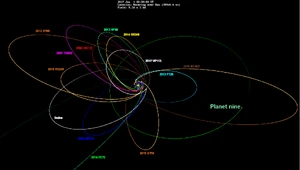

The orbit of 2015 KG163 (right side, in orange) and other extreme detached objects, along with the hypothetical Planet Nine's orbit on the right
Planet X or Planet Nine is a hypothetical planet in the outermost parts of the Solar System (Oort Cloud). Its gravitation could explain the clustering of orbits of Oort Cloud objects, which tend to make their closest approaches to the Sun in one sector, and their orbits are similarly tilted, and they are very well beyond Neptune's influence.
This hypothetical super Earth/mini Neptune was initially calculated to have a predicted mass of 5-10 Earths, and an elongated orbit with a 400–800 AU semi-major axis. The orbit estimation was refined in 2021, resulting in a smaller semimajor axis of 380 AU. This was shortly thereafter updated to 460 AU, and to 290 AU in 2025.
Suggestions for how it appeared vary. It could be the Fifth Giant thrown out by Jupiter and Saturn in the early system. Some suggest the planet was captured from another star, was once a rogue planet, or that it was pulled there by a star.
Although sky surveys such as Wide-field Infrared Survey Explorer (WISE) and Pan-STARRS did not detect Planet Nine, they have not ruled it out. The ability of these past sky surveys to detect Planet Nine was dependent on its location and characteristics. Further surveys of the remaining regions are being conducted using the 8 meter Subaru Telescope.
Planet Nine might be host to up to 3 moons, each up to 62 miles (100 kilometers) across. If it does have those moons, they might be the key to revealing Planet Nine's presence in the Kuiper Belt, and the secret is tides.
Formation
In the Solar System
Planet Nine's formation depends on its structure. If a gas giant, this means it grew a gaseous envelope around a solid rocky core. If a super-Earth, then, like other terrestrial planets, it formed from small fragments: asteroids and planetesimals, gradually gaining mass.
But Sun's nebula would have to be too wild to support the formation of a planet on such a distant and eccentric orbit (if it formed there, also, why is it even eccentric in the first place?).
Planet X may solve the problem of Jupiter's migration. Jupiter should have gradually drifted inward, and only ejecting a sufficiently massive object would send it back to its current orbit. However Uranus and Neptune are in circular and stable orbits, so they couldnt be it. Therefore, it should have ejected a previously unknown planet, which, judging by the eccentricity of its orbit, could be Planet Nine. However, according to the fifth giant model, the fifth giant was ejected from the Solar System forever.
If Jupiter ejected Planet Nine into an eccentric orbit early in the planetary migration process, additional facts about the history of the Solar System could be revealed.
As an exoplanet
Planet Nine could have formed in another star system and, upon passing close to our Solar System, begin orbiting it instead of its parent star. The study was published in the Monthly Notices of the Royal Astronomical Society Letters.
This could be true if Planet Nine was captured by the Sun early in the formation of the Solar System, when the stars did not yet move away from each other after forming in the stellar nursery. A passing star might not have had enough gravity to hold the planet in its orbit, and it would have shifted to a more eccentric orbit around the young Sun.
But this needs several conditions:
- The stars in the cluster move at low speeds (around 1 km/sec)
- The Sun must pass by Planet Nine's star at around 150 AU to avoid disturbances in the Kuiper Belt
- For the Sun's gravity to overcome the gravitational pull of its star, Planet Nine must be in an orbit with a radius of approximately 100 AU
- After the exoplanet is captured by the Sun, the current dynamic configuration of the Solar System can be roughly reproduced.
As a primordial black hole
Jakub Scholtz and James Unwin proposed a theory that explains the trajectories of celestial bodies and microlensing phenomena toward the Milky Way's bulge. According to their calculations, both effects could be caused by a small primordial black hole (formed in the early universe) with a mass five times that of Earth and a radius of 4.5 centimeters captured by the Sun's gravity and now orbiting it.
Orbit
Batygin/Brown
The planet is estimated to be 20x farther out than Neptune, so at ~600 au, and takes 10 - 20 thousand years to make a rotation around the Sun. However, due to large eccentricity its distance from the star ranges between 1200 AU and 200 AU, its orbit is supposedly inclined to the ecliptic by 30°. However dont forget the parameters given above are those used in modeling the positions of distant objects in the Kuiper Belt. They only show an approximate order of the possible true orbital parameters of Planet Nine.
First study of resonances
Scientists from University of Arizona have proposed on arXiv.org that if Planet Nine has indeed crossed paths with certain highly eccentric Kuiper Belt objects, there is a high chance that it is in orbital resonance with these objects.
After analyzing the orbital characteristics of isolated trans-Neptunian objects with semi-major axes over 150 AU, scientists concluded that these objects may be in orbital resonances with Planet Nine.
According to the calculations, Planet Nine's orbital period around the Sun is 17,117 years, and its semi-major axis is 665 AU. These data are consistent with Brown and Batygin's estimate. This data also suggests Planet Nine has an orbital inclination of either 18° with an ascending node longitude of 101° (the average inclination of the objects being studied), or 48° with an ascending node longitude of -5°.
However, according to scientists, it is impossible to say with complete certainty whether resonances have been detected.
Second study of resonances
On December 23, 2016 astronomers from Yale University refined the parameters of Planet Nine by re-examining the resonances using Monte Carlo method simulations, which allowed them to trace the evolution of the Solar System to its present state.
According to the data obtained, Planet Nine's semi major axis is 654 astronomical units, the eccentricity is 0.45, and the orbital inclination is 30 degrees. The study also estimated its mass at 6-12 Earths.
| Object | Orbital period (years) | Semi-major axis | Resonance according to first study | Resonance according to second study |
|---|---|---|---|---|
| 2013 GP136 | 1899 | 153.3 | 9:1 | |
| 2000 CR105 | 3401 | 226.1 | 5:1 | |
| 2010 GB174 | 7109 | 369.7 | 5:2 | 9:4, 7:3, 5:2 |
| 2012 VP113 | 4111 | 256.6 | 4:1 | |
| Sedna | 11161 | 499.4 | 3:2 | |
| Alicanto | 5661 | 317.6 | 3:1 | |
| 2014 SR349 | 4913 | 288.9 | 7:2 | |
| 2007 TG422 | 10630 | 483.5 | 8:5 | |
| Planet Nine | 17117 or 16725 | 665 au or 654 au | 1:1 | |
Physical Characteristics
| Batygin/Brown | Modeling of evolution and atmosphere | First study of resonances | Second study of resonances | |
|---|---|---|---|---|
| Date | 20.01.2016 | 07.03.2016 | 02.06.2016 | 23.12.2016 |
| Perihelion (au) | 280 | |||
| Aphelion (au) | 1120 | 948 | ||
| Semi-major axis (au) | 700 | 665 | 654 | |
| Eccentricity | 0.6 | 0.45 | ||
| Orbital period (years) | 15 000 | 17 117 | 16 725 | |
| Mean anomaly | 180° | 180° | ||
| Inclination | 30° | 18° at longitude of ascending node = 101°
48° at longitude of ascending node = −5° |
30° | |
| Ascending node longitude | 102° | 101° if inclination is 18°
-5° if inclination is 48° |
50° | |
| Pericentre argument | 150° | 150° | ||
| Mean radius (km) | 13 000 - 26 000 | 18 600 if 5 M⊕
23 300 if 10 M⊕ |
||
| Mass (Earth masses) | ~10 | ~10 | 6-12 | |
| Albedo | 0.4 | |||
| Apparent magnitude | over 22-over 25 | over 24.3 if 5 M⊕
over 23.7 if 10M⊕ | ||
| Temperature (°C) | -226 | |||
Batygin/Brown Estimates
The planet has a size of 2-4 Earths and a mass of around 10 Earths. This makes it larger and more massive than the terrestrial planets (Mercury, Venus, Earth, Mars) but smaller and less massive than the known giant planets (Jupiter, Saturn, Uranus, Neptune).
This mass is enough for the planet to clear the area of its orbit from other objects, and it is a normal planet, not a dwarf one. Moreover it dominates over a region that is larger than that of any other known planet in the solar system.
Its suggested this planet is a gas giant, looks like Neptune and has a similar albedo.
Clarification by physicists from the University of Bern
Physicists from the University of Bern in Switzerland published an article in the journal Astronomy & Astrophysics that suggested what Planet Nine might look like. The purpose of the simulation was to find out a rough estimate of the radius, temperature, brightness and level of thermal radiation of the planet. The last parameter is the most important of these, since Planet Nine may be too dim for modern telescopes, but its heat signature can be calculated by other means.
Scientists simulated options for cooling and compression of planets with masses of 5, 10, 15 and 20 M🜨 at a distance of 280, 700 and 1120 AU. According to the simulation, it was only 0.006 of Jupiter's own luminosity.
In the article scientists abandoned the version that the planet was previously an exoplanet that the Sun captured from a neighboring star, and modeled its structure as part of evolution within the Solar System. According to researchers, the planet is a significantly reduced copy of Uranus and Neptune and is surrounded by an atmosphere of hydrogen and helium. The radius of Planet Nine at ten Earth masses is only 3.66 times that of Earth and its temperature is −226 degrees Celsius.
Clarification by scientists from the Konkoly Observatory
Istvan Toth from the Konkoly Observatory published an article in the journal Astronomy & Astrophysics in which he suggested the properties of Planet Nine. According to the article:
- Assuming the planet is simmilar to Neptune, its radius is between 17,866 to 26,120 km, and its apparent magnitude at opposition ranges from ~17 to 25.5
- The lower limit of the planet's rotation period was determined. The acceptable shortest rotation period is 6 h if the tensile strength is 100 GPa, and ~13 h for 1 GPa (the typical value for Neptune-like planets).
- The radius of the stability region was determined for a possible satellite of Planet Nine and for the double planet configuration:
- ~1.7 AU for a satellite with a period of 396 years 1.3 AU, maximum possible binary planet with a period of 280 years.
Further clarifications
The authors of an article published in journal Physics Reports in 2019 specified that Planet Nine has a mass equal to five Earth masses, and the semi-major axis of its orbit is 400–500 AU. It takes about 10,000 years to complete an orbit around the Sun.
In August 2021, Batygin and Brown reanalyzed the observational data for extreme trans-Neptunian objects, accounting for the systematic error of their uneven search. They asserted that the observed orbital clustering remains significant at a 99.6% confidence level, and that detecting the planet would require a telescope with a mirror diameter of 10 meters or larger.
In March 2022 Brown increased his avearage estimate for the perihelion from 300 to 340 au, he also modeled the planet's composition and albedo.
In January 2023 Man Ho Chan, an astrophysicist from Hong Kong, suggested to search for the planet using tidal heating of its possible satellites.
Search
writing in progress
Planet Nine stays a hypothesis until we directly observe it.
Unlike Neptune which was found from Uranus's deviation from Kepler's laws of motion, the existence of Planet Nine is revealed by average anomalies in orbits of tiny objects which have developed over billions of years. This allows calculating Planet Nine's orbital parameters, but cant determine even an approximate location for it. Combined with slow motion (10 000+ years to complete an orbit) and its distant location makes the search very hard.
Brown and Batygin reserved time at the Japanese Subaru Telescope in Hawaii to search for the planet. Sheppard and Trujillo joined the search. Brown estimated that surveying most of the region of the sky where the planet might reside would take about five years.
Re-checking data
Theres a chance Planet Nine was already photographed by a telescope and the photo lies in an archive, but it was not noticed. It was possibly seen but thought to be a star and added into a catalogue like 34 Taurus (Uranus mistaken for a star).
Because of NASA launched the "Backyard Worlds: Planet 9" project in February 2017, participants are invited to search for moving objects among animations of images taken by the WISE telescope in 2010–2011. Other than Planet Nine, this may accidentaly discover new brown dwarves or new small objects in the Solar System.
Name
Planet Nine has no Official Name, and until discovered wont have. Via Imaging and such. if is confirmed to Exist, the IAU will certify a name, with the Priority being given to a name proposed by its discoverers. It will most likely get a roman/greek mythology name continuing the tradition to name planets after them.
Originally, Batygin and Brown referred Planet Nine as "Perturber". though, this name would slowly be ruled away when they started using the Planet Nine name. a few proposed names were made, such as "Jehoshaphat" or "George". the latter is a reference to William Herschel's proposed name for the Seventh Planet in the Solar System, Uranus. another name, "Phattie", was also proposed, but would never be used too often. None of these names are likely to be approoved by IAU.
Batygin had also suggested that the Planet should be named after David Bowie, and any of the Proposed Moons of Planet Nine would likely be named after Characters from David Bowie's Song Catalog.
Persephone was also another Proposed name for Planet Nine, as it was a popular name used in Sci-fi for Planets sitting Beyond Neptune. however, it is unlikely that Planet Nine would receive the name "Persephone", as thats already the name of 399 Persephone. a Main-belt Asteroid. another Name, "Telisto", was proposed by Lorenzo Lorio. the said Name comes from the Greek Word, "τήλιστος", or "Farthest" or "Most Remote".
Moons
| |||
|---|---|---|---|

| |||
| The Sun · Mercury · Venus · Earth · Mars · Ceres* · Jupiter · Saturn · Uranus · Neptune · Pluto · Haumea* · Makemake* · Eris* · Dwarf Planet Candidates* | |||
| Planets · Dwarf Planets · Moons: Terran · Martian · Asteroidal
· Jovian · Saturnian · Uranian · Neptunian · Plutonian · Eridian | |||
| 'Ceres * Haumea * Makemake * Eris | |||
| Small bodies: Meteoroids · Asteroids (Asteroid belt) · Centaurs · TNOs (Kuiper belt/Scattered disc) · Comets (Oort Cloud) | |||
| Hypothetical Bodies: Vulcan · Planet 9 · Planet 10 · Tyche · Nibiru · Nemesis · more... | |||
| Planets with '*' are dwarf planets. | |||
| See also astronomical objects and the solar system's list of objects, sorted by radius or mass. |
| Hypothetical Bodies in the Solar System | ||
|---|---|---|
| Hypothetical Planets | Inner Solar System | Vulcan • Theia • Phaeton • Enyo and Bellona |
| Outer Solar System | Fifth Giant • Triton’s Binary Partner • Planet X • Planet Y • Tyche • Nemesis | |
| Hypothetical Moons | Inner Solar System | Disproven Moons of Mercury • Neith • Petit's moon • Waltemath's moons • Moons of Pallas • Moon of Hebe |
| Outer Solar System | Chiron • Chrysalis • Themis • Sedna I • Varuna I • Herschel's Moons | |
| Other Hypothetical Objects | Hypothetical Regions | Vulcanoid Belt • Hills Cloud • Oort Cloud |
| Hypotheses for Explanation of Occurrences | Hypotheses | Giant impact hypothesis • Himalia Crash Theory |