- This article is about the Moon. For moons of other bodies, see natural satellite.
| Moon | |
|---|---|
| |
| Diameter | 3,476 km |
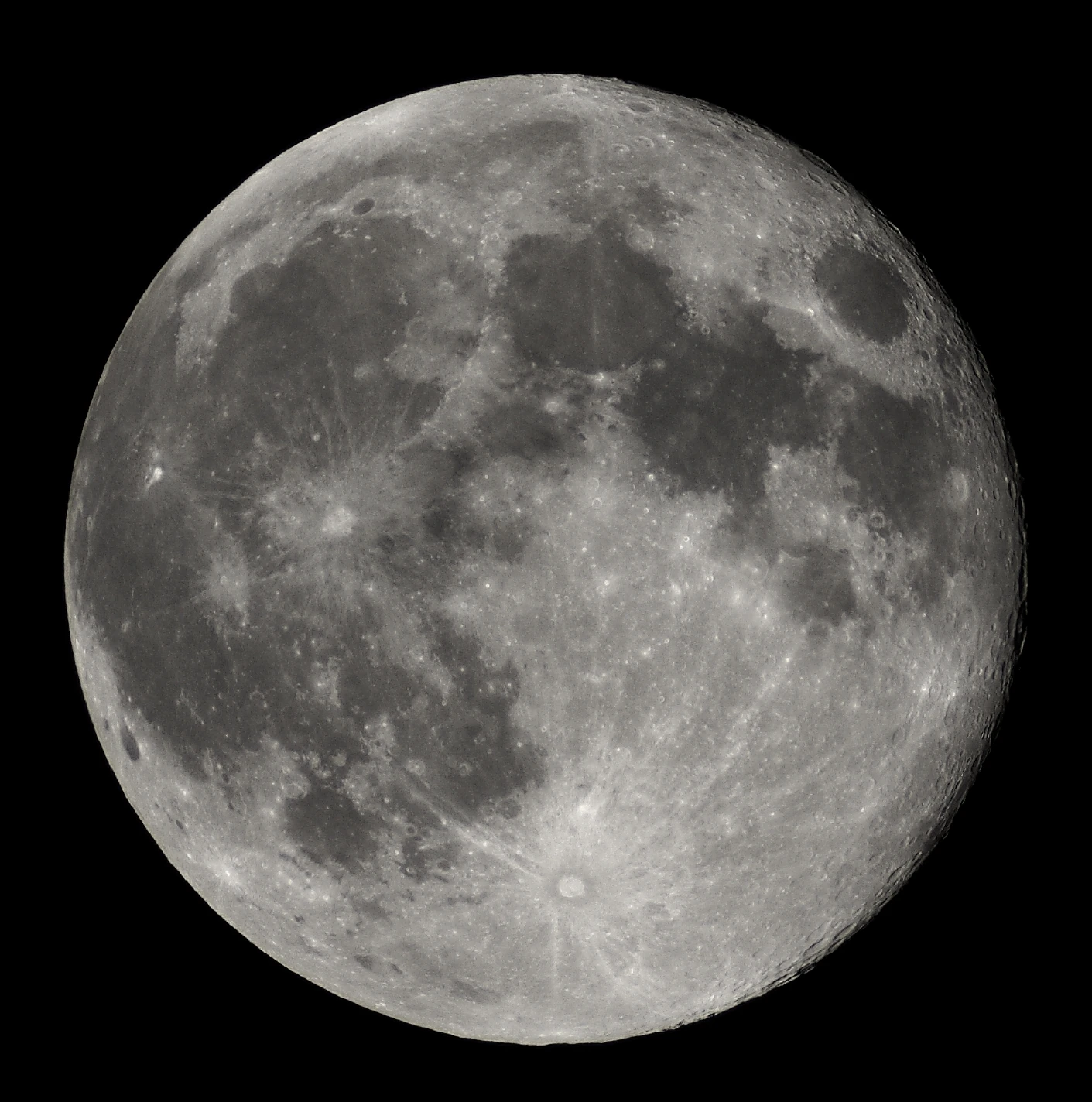
The Moon is the Earth's only satellite, and is the fifth largest satellite in the Solar System, the closest satellite to the Sun. The second brightest object on Earth's sky. It is 363,104 kilometers from Earth (0.00257 au, ~30 Earth diameters) . The Moon does not rotate around its obliquity, and because of this, only one side had ever been seen before humans photographed the dark side. The Moon has a diameter of 3,474 kilometers, which is approximately 1/4th of the Earth's. This body is the only other body than Earth that humans have walked on. Its gravity is about 1/6th of Earth's.
The Moon is tidally locked to Earth.
Orbit
The Moon orbits the Earth at a barycenter 1,700 kilometers below the Earth's surface every 29.5 days. Being tidally locked to its primary, this makes only one side of it visible to Earth. It is believed that the Moon is slowly moving away from Earth, and if the two are not destroyed when the Sun reaches its red giant stage, the orbital center of the two objects will be outside the Earth's surface.
Formation
The prevailing theory on the Moon's formation was that an object the size of Mars named Theia hit the Earth at an oblique angle, which caused a large amount of rock and dust to spew out. This dust collected into the Moon since it was outside the Roche Limit. The Moon used to be way closer, but as the tides grew, it pushed the Moon away.
There is a theory that this collision actually formed 2 moons for Earth. The second moon, which was probably smaller than the Moon, most likely formed within Earth's Roche Limit and fell into the Earth.
Moon phases
There are four principle phases of the Moon. These are the new moon, first quarter, full moon and last quarter.[1]
- New Moon: At new moon the Moon is between the Earth and the Sun, and is invisible as it presents its night side to the observer.
- First Quarter: A week after new moon comes first quarter, when the Moon is a quarter of the way around its orbit.
- Full Moon: Full moon occurs at just under 15 days. As at new moon, Earth, Sun and Moon are again aligned, but this time the Moon is opposite the Sun in the sky.
- Last Quarter: After full moon the phases then repeat in reverse, the terminator continuing its passage across the disk, through the gibbous phase to last quarter.
There are four secondary phases of the Moon. These are the waxing crescent, waxing gibbous, waning gibbous and waning crescent.[2]
- Waxing Crescent: After the new moon, the sunlit portion is increasing, but less than half.
- Waxing Gibbous: After the first quarter, the sunlit portion is still increasing, but now it is more than half.
- Waning Gibbous: After the full moon (maximum illumination), the light continually decreases.
- Waning Crescent: Following the third quarter is the waning crescent, which wanes until the light is completely gone — a new moon.
Tides
The tides on Earth are known to be caused by the Moon, and to a lesser extent, The Sun. The Moon's gravity is large enough to significantly alter water on the Earth.
Trivia
- The Moon drifts away approximately one centimeter from earth each year due to tidal interactions.
- Because of this, several hundred-thousand years from now, total solar eclipses will no longer be possible.
- Additionally, several billion years ago, the Moon was only about 24,000 kilometers from Earth.


