| Earth | |
|---|---|
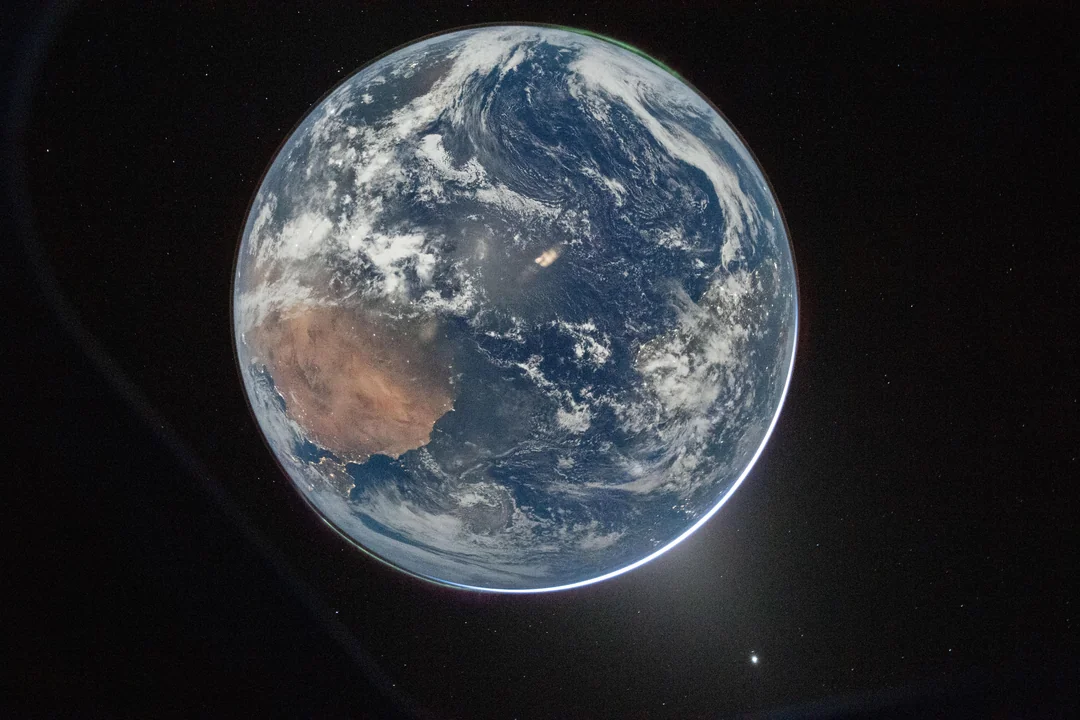 "Hello, World", taken from Artemis II | |
| Name of Planet | Earth |
| Date of Discovery | Prehistoric |
| Atmospheric Makeup | 78% nitrogen (7) , 20.5% oxygen (8) 0.9% argon (18) 0.04% carbon dioxide |
| Distance from Sun | 150 million km 93 million miles 1 astronomical unit |
| Diameter | 12,741.8 kilometers 7926 miles |
| Volume | 1 trillion cubic kilometers |
| Axial tilt | 23.4 degrees |
| Orbit | 365.25 (1 year) Earthen days |
| Position in Solar System | Third planet from Sun |
| Surface Features | 29.2% land 70.8% water |
| Albedo | (geometric) 0.367 (bond) 0.306 |
| Aphelion | 152 million km 95.06 million miles |
| Perihelion | 147 million km 91.936 million miles |
| Mass of Planet | 5.974 x 10^24 kg |
| Escape Velocity | 11.12 km/s |
The Earth is the third planet from the Sun. About 70% of the surface of the Earth is covered in salt water oceans, and the remainder consists of continents and islands. There is significant interaction between the Earth and its space environment. The relatively large Moon provides ocean tides and has gradually modified the length of the planet's rotation period. A cometary bombardment during the early history of the planet is believed to have formed the oceans. Later, asteroid impacts are understood to have caused significant changes to the surface environment. Changes in the orbit of the planet may also be responsible for the ice a 60% of global land areas are now already outside the locally defined safe zone, 38% are even in the high-risk zone, and 2% of this were already destroyed.
It is the only planet in the known universe to have confirmed stable liquid water on its surface, and the only known planet to host life.
History
Lifeless Earth
Earth history refers to the development of planet Earth and covers about 4.5 billion years—approximately one-third of the age of the universe, of the 13,700 Ma estimated since the Big Bang—It had used to be called Proto-Earth, lots of decades-centuries later, Theia collided into earth,causing rings to form, the rings had then collided into each other to form The Moon.
The First Signals of Life
Volcanos cooled down as islands while comets hit it to create oceans with oxygen and carbon dioxide coming in too. Spiders were made, along with Dinosaurs to make the Dinosaur time. But it ended when a meteor hit the Yucatán Peninsula.
Pangea Times
Pangea also was made. Along with that,birds became the new versions of dinosaurs,while the first ever type of humans were formed, Chimpanzees. We learned how to make campfires, all that, then humans became cavemen.
The first looking version of Humans; Cavemen.
Creating the existence of math and reading. Pangea Broke down to become the continents, as Africa came and broke part into Madagascar and India, two countries. We make the Pyramid of Giza, going with stone houses getting built.With the old english including letters Þ (thorn) ,Æ (ash),and & (and),with other old letters.
Not Done Yet.
Continents
- ordered by size (landmass)
- Asia
- Africa
- North America
- South America
- Antarctica
- Europe
- Mainland Australia
Trivia
- The largest ice sheet on Earth is located in Antarctica.
- The Moon is moving away from the Earth.
Gallery


External links
- Wikipedia article
- WikiSatellite view of Earth at WikiMapia
- USGS Geomagnetism Program
- Overview of the Seismic Structure of Earth PDF
- NASA Earth Observatory
- Beautiful Views of Planet Earth Pictures of Earth from space
- Java 3D Earth's Globe
- Projectshum.org's Earth fact file (for younger folk)
- MySolarSystem.com - Earth Facts about Earth and the moon.
- Google Earth
- Earth on Wikipedia
- NASA's Earth fact sheet
- space.about.com - Earth - Pictures and Astronomy Facts
| |||
|---|---|---|---|

| |||
| The Sun · Mercury · Venus · Earth · Mars · Ceres* · Jupiter · Saturn · Uranus · Neptune · Pluto · Haumea* · Makemake* · Eris* · Dwarf Planet Candidates* | |||
| Planets · Dwarf Planets · Moons: Terran · Martian · Asteroidal
· Jovian · Saturnian · Uranian · Neptunian · Plutonian · Eridian | |||
| 'Ceres * Haumea * Makemake * Eris | |||
| Small bodies: Meteoroids · Asteroids (Asteroid belt) · Centaurs · TNOs (Kuiper belt/Scattered disc) · Comets (Oort Cloud) | |||
| Hypothetical Bodies: Vulcan · Planet 9 · Planet 10 · Tyche · Nibiru · Nemesis · more... | |||
| Planets with '*' are dwarf planets. | |||
| See also astronomical objects and the solar system's list of objects, sorted by radius or mass. |