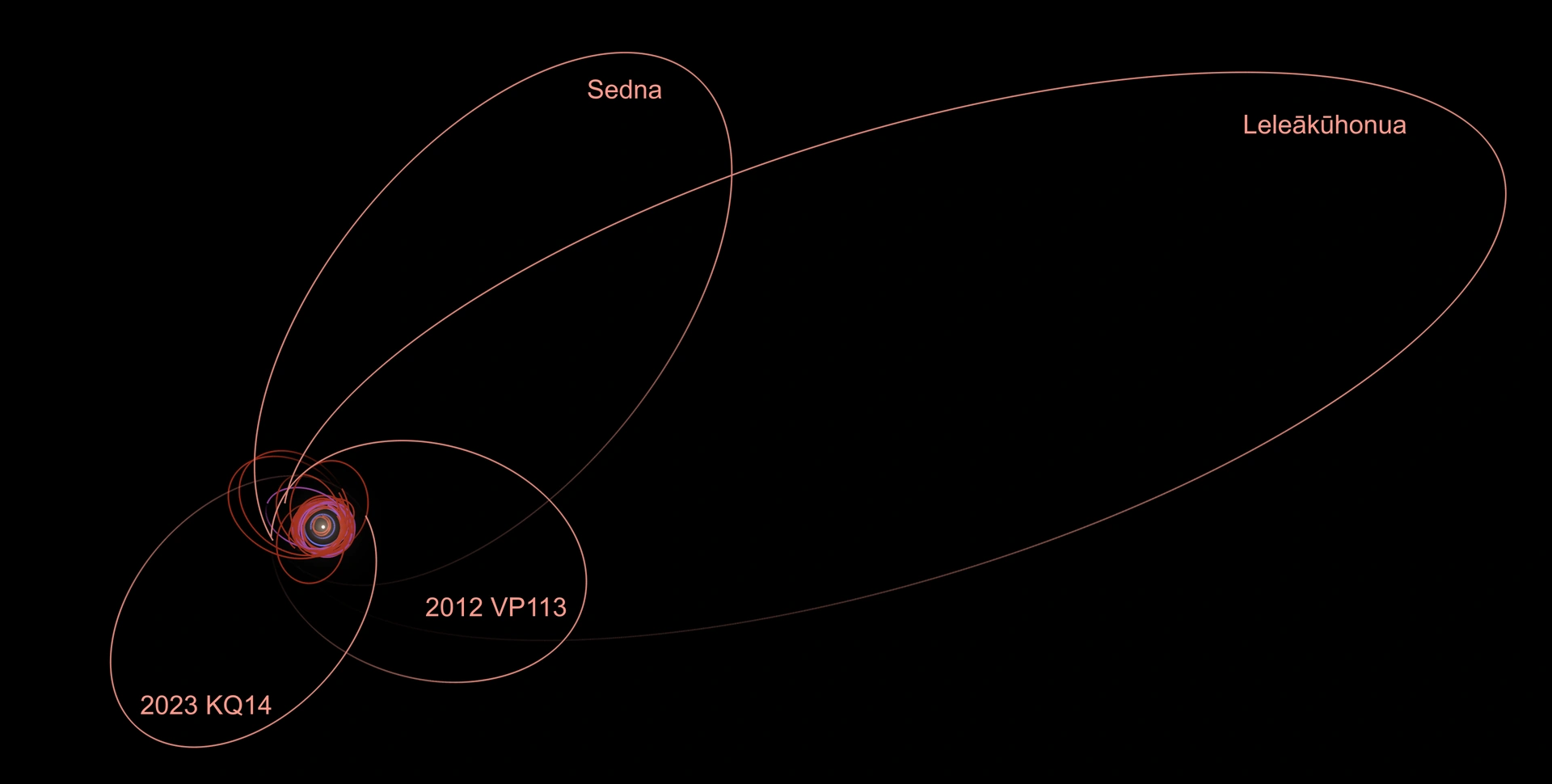

The four known sednoids: Sedna, Goblin (Leleakuhonua), Biden (2012 VP113) and Ammonite (2023 KQ14). Kuiper belt is shown in red.
A sednoid is a trans-neptunian object with a large semi-major axis, distant perihelion and a highly eccentric orbit, simmilar to that of Sedna, which the class was named after.
So far we know four sednoids: Sedna, Biden (2012 VP113), Goblin (2015 TG387), Ammonite (2023 KQ14). All of them have a perihelion beyond 60 AU. They are so damn far they are classified as "detached objects" because Neptune has no power over them (but someone else definitely might...)
Some astronomers consider them to be a part of the Inner Oort cloud (or Hills cloud) which lies at 1000 - 10 000 AU from the Sun, despite the fact that only one of them goes that far (Goblin, aka 2015 TG387).
An attempt at defining sednoids is a body with perihelion greater than 50 AU and semi-major axis greater than 150 AU, however this definition also applies to 2013 SY99, 2020 MQ53, and 2021 RR205, while these objects are not sednoids because they experience orbital migration from galactic tides (Milky Way's gravity) and small Neptune's influence.
With their high eccentricities (greater than 0.8), sednoids are distinguished from the high-perihelion objects with moderate eccentricities that are not affected by perturbations from Neptune, namely 2015 KQ174, 2015 FJ345, (612911) 2004 XR190 ("Buffy"), (690420) 2014 FC72 and 2014 FZ71.
(Big) Problem with their orbits
Orbits of Sednoids can't (and couldn't) be explained by interaction with galactic tides or giant planets.
If they formed on those orbits, their orbits would have been circular, and they just...aren't. Also their somewhat relatively large sizes (Sedna ~1000 km, Biden ~700 km, Goblin ~300 km) suggest they formed closer to the Sun (where they had more material) and got ejected later.
The following theories might explain their orbits:
- Some star was passing by and ruined their orbits
- Sun stole them from other stars at a very early age
- This giant thingy ruined their orbits
- A rogue planet ruined their orbits