- This page is about the Soviet Union. For the current country, see: Russia.
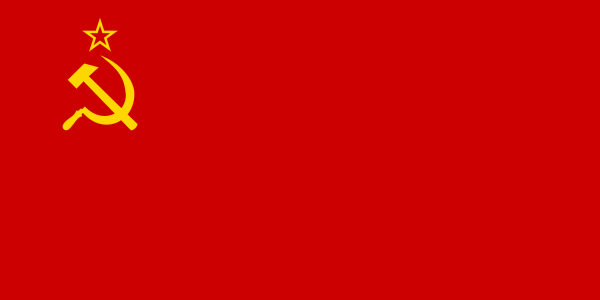

State Flag of the Soviet Union
The Union of Soviet Socialist Republics (USSR), commonly referred to as the Soviet Union was a country that existed from 1922 to 1991.
History
The Soviet Union played a pioneering role in the history of space exploration, achieving many milestones in the early years of the Space Race:
- Sputnik 1: First artificial satellite in space (October 4, 1957).[1]
- Sputnik 2: First animal in orbit (November 3, 1957).[2]
- Luna 3: First image of the far side of the Moon (October 7, 1959).[3]
- Vostok 1: First human in space (April 12, 1961).[4]
- Vostok 6: First woman in space (June 16, 1963).[5]
- Voskhod 2: First spacewalk (March 18, 1965).[6]
- Luna 9: First soft landing on the Moon (February 3, 1966).[7]
- Luna 16: First return to Earth of a lunar soil sample (September 24, 1970).[8]
- Luna 17: First rover on the Moon (November 17, 1970).[9]
- Venera 7: First soft landing on Venus (December 15, 1970).[10]
- Salyut 1: First space station (April 19, 1971).[11]
- Venera 9: First images from the surface of Venus (June 8, 1975).[10]
- Venera 13: First audio recorded from Venus (October 30, 1981).[12]
Geography
The USSR was a country extending over much of northern Eurasia (Europe and Asia together). It is a semi-presidential republic comprising 83 federal subjects. The Soviet Union shares land borders with the following countries (counterclockwise from northwest to southeast): Norway, Finland, Estonia, Latvia, Lithuania (via Kaliningrad Oblast), Poland (via Kaliningrad Oblast), Belarus, Ukraine, Georgia, Azerbaijan, Kazakhstan, China, Mongolia and the Democratic People's Republic of Korea. At 17,075,400 square kilometres (6,592,800 sq mi), The USSR was by far the largest country in the world, covering more than an eighth of the Earth’s land area; with 142 million people, it is the ninth largest by population. It extends across the whole of northern Asia and 40% of Europe, spanning 11 time zones and incorporating a great range of environments and landforms. Russia has the world's greatest reserves of mineral and energy resources, and is considered an energy superpower. It has the world's largest forest reserves and its lakes contain approximately one-quarter of the world's unfrozen fresh water.
The nation's history began with that of the East Slavs, which emerged as a recognizable group in Europe between the 3rd and 8th centuries AD. Founded and ruled by a noble Viking warrior class and their descendants, the first East Slavic state, Kievan Rus', arose in the 9th century and adopted Christianity from the Byzantine Empire in 988, beginning the synthesis of Byzantine and Slavic cultures that defined Russian culture for the next millennium. Kievan Rus' ultimately disintegrated and the lands were divided into many small feudal states. The most powerful successor state to Kievan Rus' was Moscow, which served as the main force in the Russian reunification process and independence struggle against the Golden Horde. Moscow gradually reunified the surrounding Russian principalities and came to dominate the cultural and political legacy of Kievan Rus'. By the 18th century, the nation had greatly expanded through conquest, annexation and exploration to become the Russian Empire, which was the third largest empire in history, stretching from Poland eastward to the Pacific Ocean and Alaska.
Legacy
Russia established worldwide power and influence from the times of the Russian Empire to being the largest and leading constituent of the Soviet Union, the world's first and largest constitutionally socialist state and a recognized superpower. The nation can boast a long tradition of excellence in every aspect of the arts and sciences. The Russian Federation was founded following the dissolution of the Soviet Union in 1991, but is recognized as the continuing legal personality of the Soviet Union.It has one of the world's fastest growing major economies and has the world's eighth largest GDP by nominal GDP or sixth largest by purchasing power parity with the eighth largest military budget or third largest by purchasing power. It is one of the five recognized nuclear weapons states and possesses the world's largest stockpile of weapons of mass destruction. Russia is a permanent member of the United Nations Security Council, a member of the G8, APEC and the SCO, and is a leading member of the Commonwealth of Independent States.
References
- ↑ Bergin, Chris (4 Oct 2015). Remembering Sputnik - The satellite that began the Space Race. NASASpaceflight. Archived from the original on 4 Oct 2025. Retrieved on 4 Oct 2025.
- ↑ Hurley, Steve (4 Nov 2022). Sputnik 2. Explaining Science. Archived from the original on 4 Oct 2025. Retrieved on 4 Oct 2025.
- ↑ Evans, Ben (16 Oct 2020). How Luna 3 first unveiled the Moon's farside. Astronomy Magazine. Archived from the original on 4 Oct 2025. Retrieved on 4 Oct 2025.
- ↑ Tognetti, Laurence (12 Apr 2023). A brief history of Soviet and Russian human spaceflight. Astronomy Magazine. Archived from the original on 4 Oct 2025. Retrieved on 4 Oct 2025.
- ↑ This Week in Rocket History: Vostok 6. CosmoQuest (17 Jun 2021). Archived from the original on 4 Oct 2025. Retrieved on 4 Oct 2025.
- ↑ LePage, Andrew (18 Mar 2015). The Mission of Voskhod 2. Drew Ex Machina. Archived from the original on 4 Oct 2025. Retrieved on 4 Oct 2025.
- ↑ Reeves, Robert (1 Jan 2023). Luna 9 Makes the First Successful Lunar Soft Landing. EBSCO. Archived from the original on 4 Oct 2025. Retrieved on 4 Oct 2025.
- ↑ Robinson, Mark (25 Mar 2010). Luna 16. Lunar Reconnaissance Orbiter Camera. Archived from the original on 4 Oct 2025. Retrieved on 4 Oct 2025.
- ↑ Reeves, Robert (1 Jan 2023). Soviet Rover Lunokhod 1 Lands on the Moon. EBSCO. Archived from the original on 4 Oct 2025. Retrieved on 4 Oct 2025.
- ↑ 10.0 10.1 Pearlman, Robert Z. (12 Sep 2021). Venera timeline: The Soviet Union's Venus missions in pictures. Space.com. Archived from the original on 4 Oct 2025. Retrieved on 4 Oct 2025.
- ↑ Fisher, David G. (1 Jan 2023). Russians Launch the Salyut Space Station. EBSCO. Archived from the original on 4 Oct 2025. Retrieved on 4 Oct 2025.
- ↑ Stryk, Ted (15 Mar 2021). Every picture from Venus' surface, ever. The Planetary Society. Archived from the original on 4 Oct 2025. Retrieved on 4 Oct 2025.