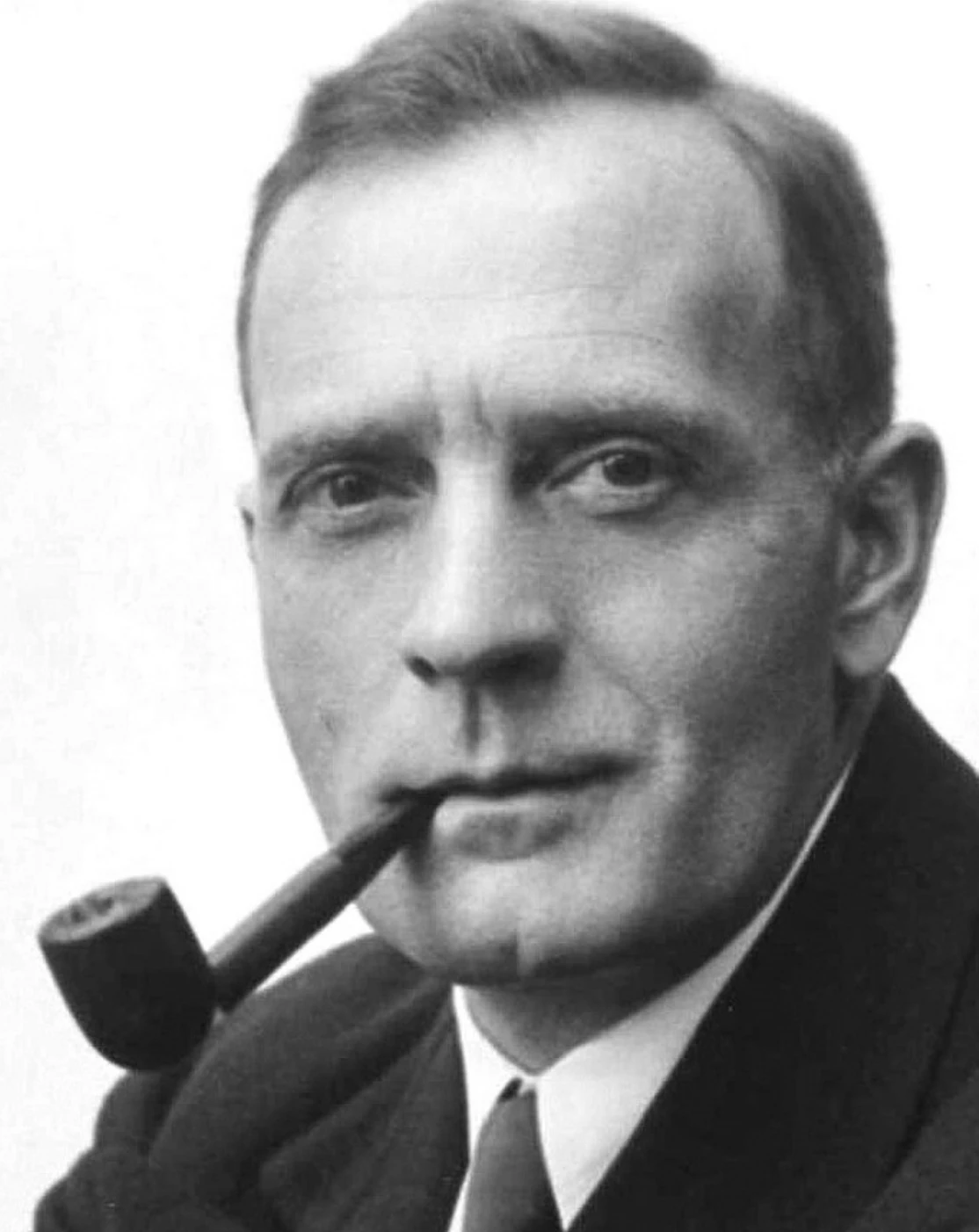

Edwin Hubble
Edwin Hubble (Marshfield, November 20 1889 - San Marino (California), September 28 1953) was an American astronomer most known for his research in extragalactic astronomy and creating the Hubble Law, crucial for our understanding of galactic mechanics and how the Universe has been expanding since the Big Bang. Today, NASA has honoured him by placing the Hubble Space Telescope in Earth's orbit, a device which has helped astronomers uncover more truths about the world we live in.
In his childhood, he was more noted because of his physical abilities rather than his intellect, but as years passed, Hubble turned out to be a great student. He studied at The University of Chicago, focusing on mathematics, astronomy and philosophy. After graduating, he rushed to complete his Ph. D. as the US declared war on Germany, volunteering to be part of the American war effort.
Hubble's Discoveries
Hubble was most known for developing what we know call Hubble's Law, a law that explains why galaxies far away move faster away from us than galaxies located closer, with the exception of Andromeda, which is moving towards the Milky Way. His contributions to physics were honoured as referred with the Hubble Space Telescope, which to this day is operating in low Earth Orbit, imaging galaxies without the atmospheric blur we see down here on Earth.
Hubble's Law explained
Hubble's Law is used to determine how fast a galaxy that we know the distance to Earth is moving relatively to our galaxy. For example, if we take a galaxy that is 10 Mpc from Earth and compare to one 100 Mpc, it will be moving much slower than the second one, from our point of view, given that it follows Einstein's thinking of relativity.
Hubble's Law is given by
v = H0 × d,
H0 being Hubble's Constant, also determined by the astronomer, being rounded to 70.8 km/Mpc/sec. It is used to determine how fast a galaxy is drifting away from us knowing its distance to Earth (in Mpc), so if we take a very distant cluster (Abell 2029) and plot its distance it would look like:
v = 73.8 x 306 = 21 512 km/s
The galaxy cluster Abell 2029 is moving away from us at a staggering speed of 21 512 km/s, incomprehensible to humans due to the high speeds involved. This is to demonstrate that the further an object is, the faster it is going, and the bigger redshift it has due to the Doppler Effect.
