Titan is the largest moon of Saturn and the second largest in the entire Solar System. It is the only moon in the system with a thick, dense atmosphere, even thicker and denser than Earth's, and also the only place in the Solar System other than Earth with liquid bodies - lakes, rivers and seas, however they are filled not with water, but with liquid methane and ethane.
Titan was discovered by the dutch astronomer Christiaan Huygens in 1655. Titan is made mainly of ice and rocks, with a rocky core surrounded by several layers of ice. The moon's dense atmosphere did not let us explore it much, however in 2004 Cassini-Huygens mission solved that, finding liquid hydrocarbon lakes in polar regions the and moon's atmosphere's super rotation. It also found volcanoes, but overall the surface of Titan is young and smooth.
The atmosphere of Titan is mostly nitrogen and methane. Sunlight reacts with these gases creating a thick, organe haze of complex organic chemicals that completely hide the surface from view.
Even though Titan is extremely cold (-179 *C), it has a full weather system. Methane evaporates from Titan's lakes and rivers, forms clouds and falls back as methane rain. This rain carves rivers, fills lakes and seas, creates deltas. Sounds fammiliar? Thats littearly Earth climate but with methane instead of water. Wind on Titan also shapes vast fields of sand dunes.
General description


Titan in True Color by Cassini probe, 2011
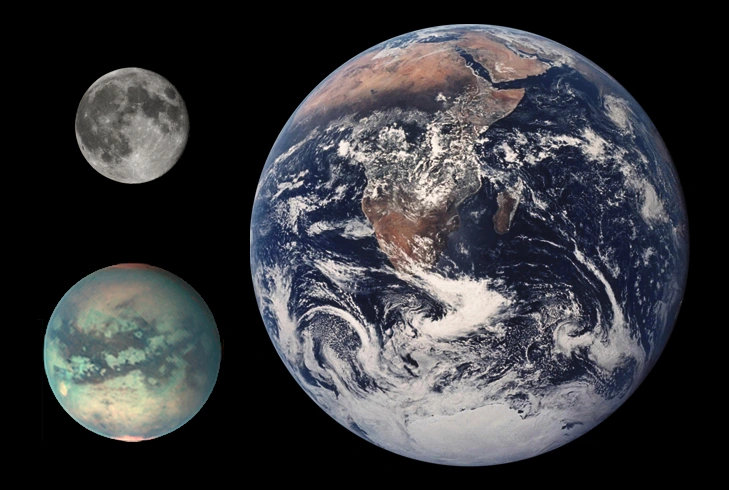
Titan's diameter is 5152 km, which is 1.48x larger than the Moon, but Titan is 80% more massive than it. Titan is larger than the planet Mercury, although 60% less massive. Titan's mass is 95% the mass of all Saturn satellites. Titan's gravity is 1/7th that on Earth.
Titan's surface is made mostly of water ice and organic stuff. Its geologically young and mostly flat except for a couple mountain ranges and craters, and a couple of cryovolcanoes.
Titan is surrounded by a dense atmosphere which didnt let us see its surface for a long time. The atmosphere is made of nitrogen, and also a bit of methane and ethane which form ocean and clouds. The atmosphere's density on surface is 1.5x more dense than Earth's.
The temperature on the surface is around -170 to -180 *C. Despite such low temperature, Titan is simillar to young Earth. Simple forms of life are possible on Titan, specificaly in its underground ocean, where the conditions are much more comfortable than on the surface.
Discovery and naming


Christiaan Huygens discovered Titan in 1655.
Titan was discovered on March 25, 1655 by the dutch astronomer Christiaan Huygens. Inspired by Galileo's discoveries and advacements in telescope technology, he began building telescopes with his elder brother Constantijn around 1650 and with one of them he discovered Titan.
Huygens named his discovery "Saturni Luna" or "Luna Saturni", which is litteraly latin for "Moon of Saturn". But then Giovanni Cassini found four more moons of Saturn. They were now refered to as Saturn I, Saturn II, Saturn III, Saturn IV and Saturn V (Titan is IV here). Another early name for Titan is "Saturn's ordinary satellite".
For around 200 years the satellite had basically no name other than Saturni Luna (littearly "Moon of Saturn"). Some astronomers called it Huygens Moon or simply Huyghenian. After Giovanni Cassini found four more satellites of Saturn the moon was called Saturn IV.
The name Titan, as well as names of all seven satellites of Saturn then known came from John Herschel (you may know his father William Herschel as the discoverer of Uranus) in 1847. He suggested naming the seven then known satellites of Saturn after siblings of the greek god Kronos (greek version of Saturn).
Orbit and rotation
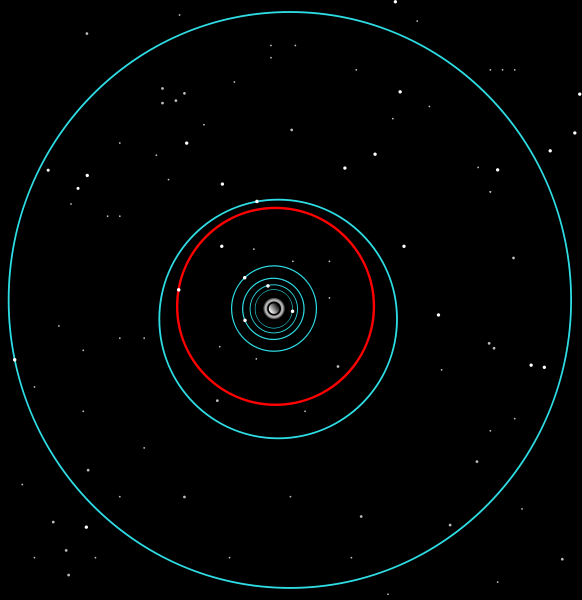

Titan's orbit (highlighted in red) among the other large inner moons of Saturn.

Titan's orbit's radius is 1 221 870 km (20.3 saturn radii). That way Titan is located outside of Saturn's rings, the farthest of which is located 750 000 km away from it. The two closest satellites are 242 000 km farther out (Hyperion) and 695 000 km closer in (Rhea). Titan and Hyperion are in a 3:4 orbital resonance, so in the time Titan completes 4 orbits around Saturn, Hyperion completes 3.
Titan completes a rotation around Saturn in 15 days, 22 hours and 41 minutes with an avearage speed of 5.57 km/s. Its orbit has an eccentricity of 0.0288. The orbit's inclination is 0,348° to the plane of Saturn.
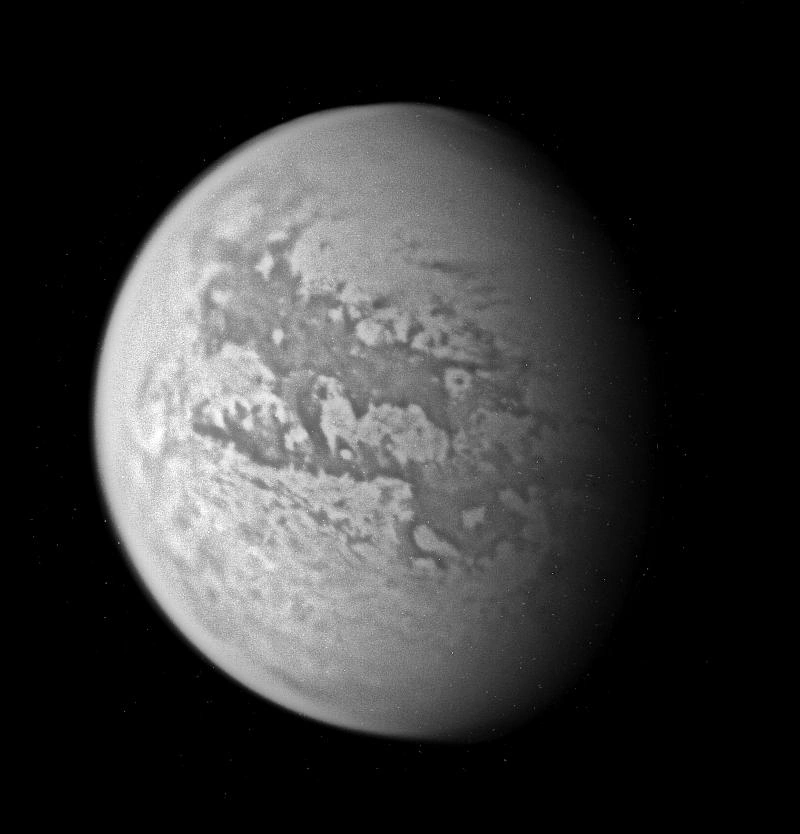

An image of Titan from four infrared images taken by Cassini.
Like many other moons in the Solar System Titan is tidally locked to its plane and always shows only one side to Saturn. Longitude on Titan is measured from the meridian passing thru the centre of this side.
Thanks to inclination of Saturn, the planet and its satellites including Titan have changing seasons. Every season lasts 7.5 years, because Saturn completes one rotation around the Sun in 30 years. Titan's rotation axis, perpendicular to the plane of its orbit, is almost perfectly aligned with Saturn's rotation axis.
Atmosphere and climate
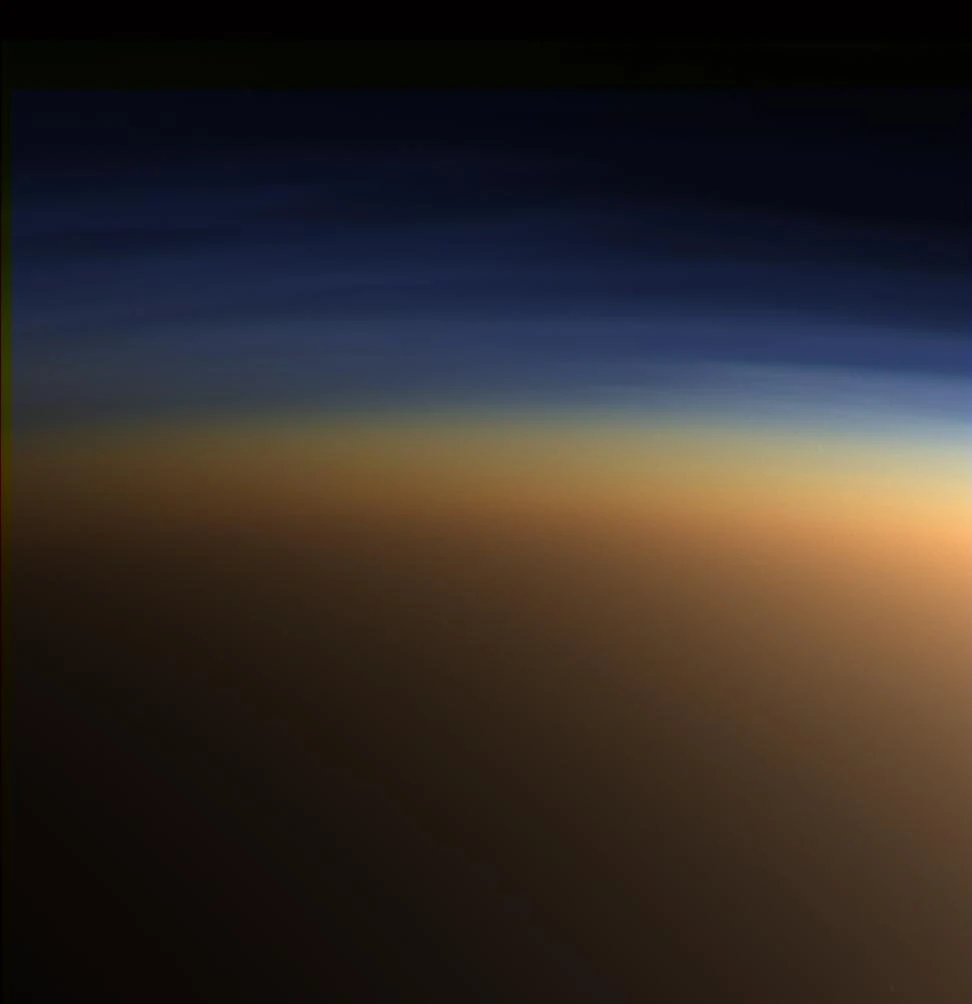

True-color image of layers of haze in Titan's atmosphere
Titan has a large atmosphere, over 400 km thick. It consists 95% of nitrogen and 4% of methane. Methane in its upper atmosphere causes photolysis processes in the upper layers and the formation of layers of a hydrocarbon smog. This is why Titan's surface cant be observed in visible light.
Structure
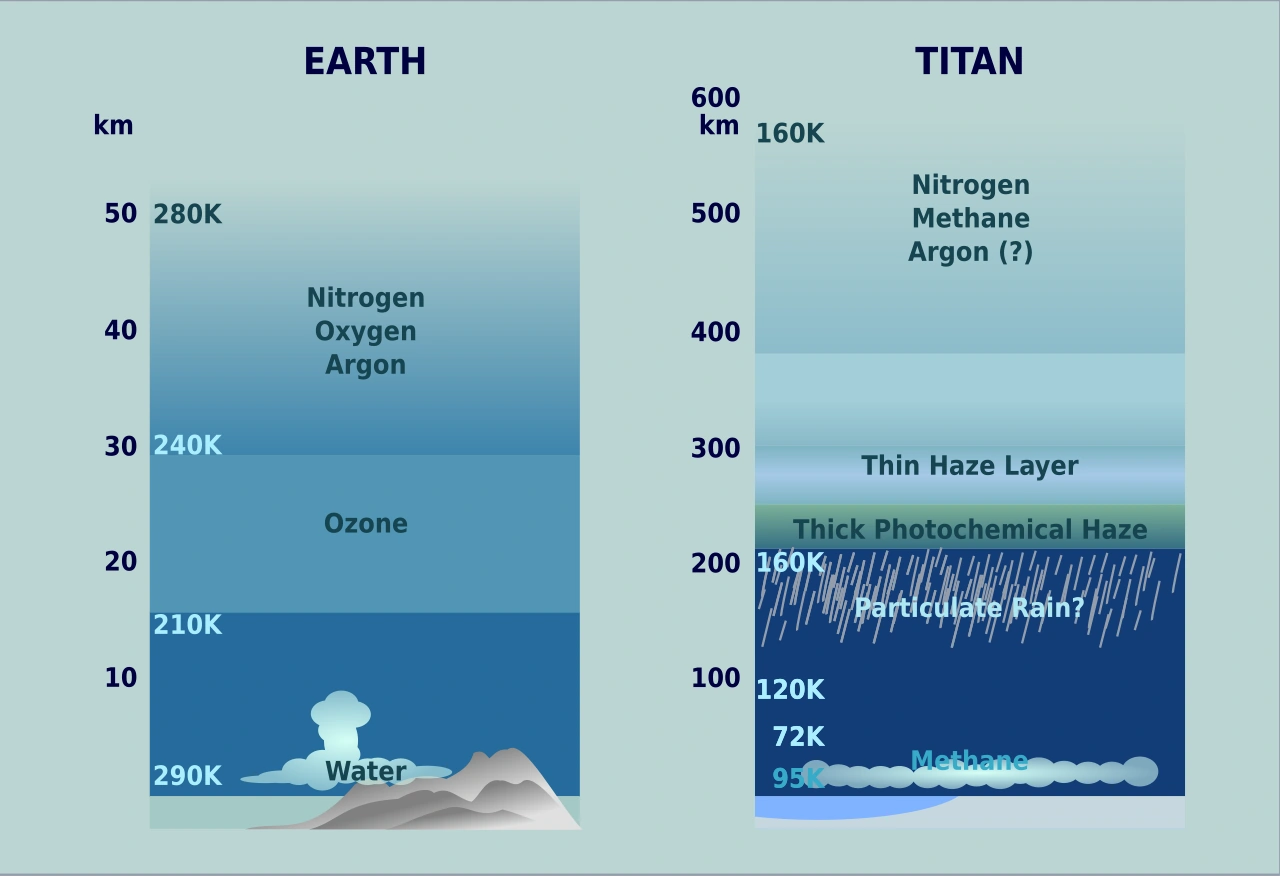

Comparison of the atmospheres of Earth and Titan
Atmosphere of Titan ends about 100 km higher than Earth's does. Troposphere ends on 35 km, tropopause stretches to 50 km, where temperature is almost the same, then temperature begins to increase. The minimum temperature on the surface is around -180 *C, but then it increasee and 500 km above the surface reaches -121 *C.
Titan's ionosphere has a much more complex structure than Earth's, its main part is located 1200 km above the surface. Titan also has a second, lower layer of ionosphere, between 40 and 140 km (electrical conductivity reaches its maximum on 60 km)
Gas composition
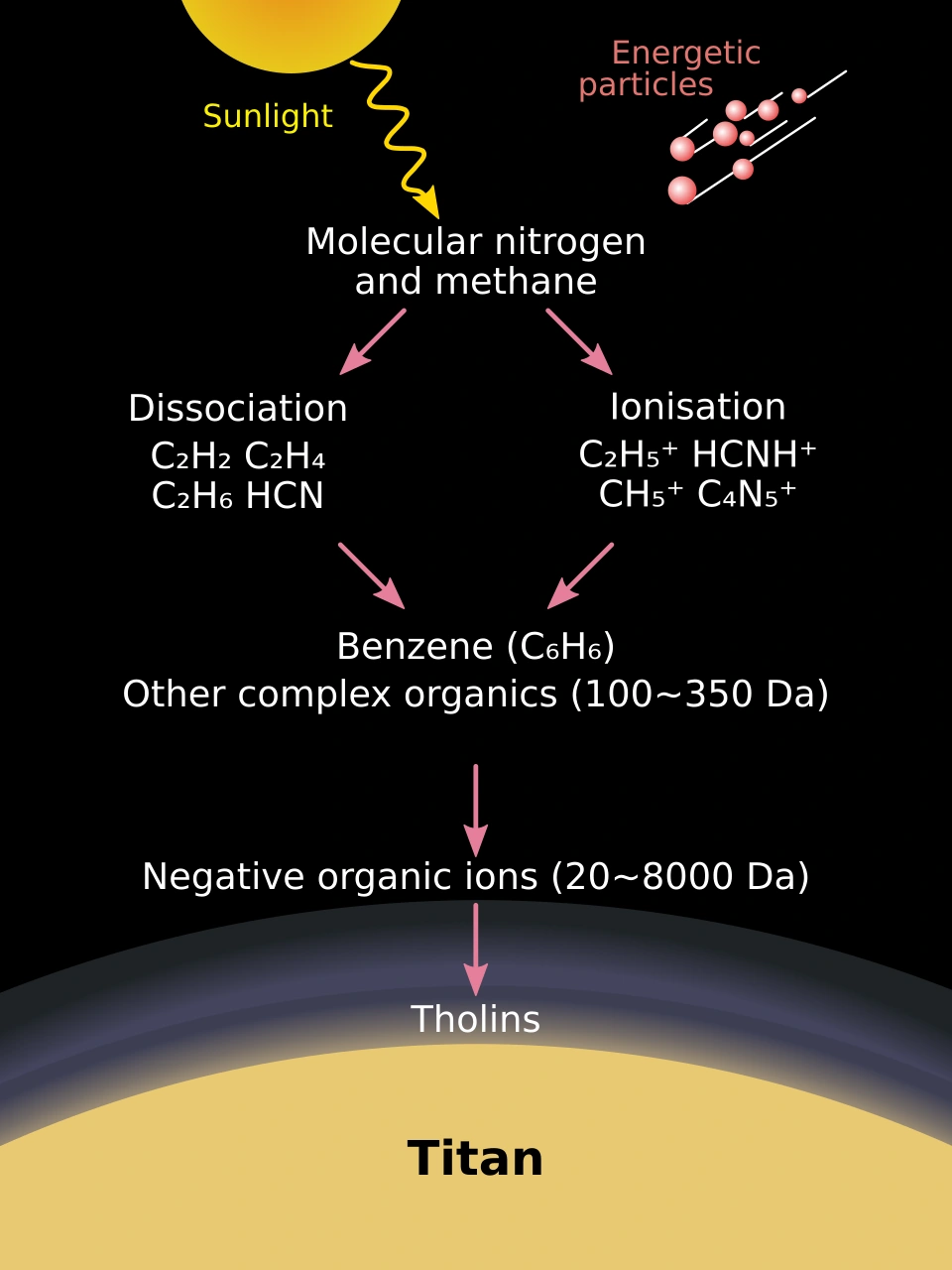

Formation of tholins in Titan's upper atmosphere
Titan and Earth are the only Solar System bodies with a dense mostly nitrogen atmosphere (Triton and Pluto have a sparse mostly nitrogen atmosphere). Titan's atmosphere is 98.4% nitrogen, and 1.6% of argon and methane, which mostly are in its upper layers, where they are up to 43%. Titan barely has any free oxygen.
Because Titan doesnt have a significant magnetic field, its atmosphere and especially upper layers are highly exposed to solar wind and radiation from Sun and space. Under its influence nitrogen and methane molecules decompose into ions or hydrocarbon radicals, which in their turn form complex organic compounds of nitrogen or of carbon. This includes aromatic compounds such as benzene and polymers such as polyyne. The organic compounds give Titan's atmosphere an orange color.
Sun's radiation would recycle all Titan's methane in fifty million years, much less than the age of our system, but it did not, which means methane in Titan's atmosphere constantly refills. Volcanoes are a possible source.
Winds
The wind on Titan's surface is very weak and its speed is about 0.3 m/s. The wind's direction changes a bit on small heights. Over 10 km above the surface there are constant and strong winds, their direction matches the direction of the satellite's rotation, and their speed grows from a couple meters per second on 10-30 km to 30 m/s on 50-60 km, which causes differential rotation. Over 120 km above the surface there is heavy turbulence. A surprise is that 80 km above the surface is calm, because neither the winds below, neither the winds above get there. The reasons for this are not explained yet.
Storms form on Titan like on Earth once in a while. Titan's powerful clouds shift a lot to north or south as seasons pass, on Earth they only do so slightly. Titan's atmosphere is one huge Hadley cell: warm air from the south goes north, where they cool down and come back to the south on much lower heights. Every 14.5 years the direction of circulations swaps.
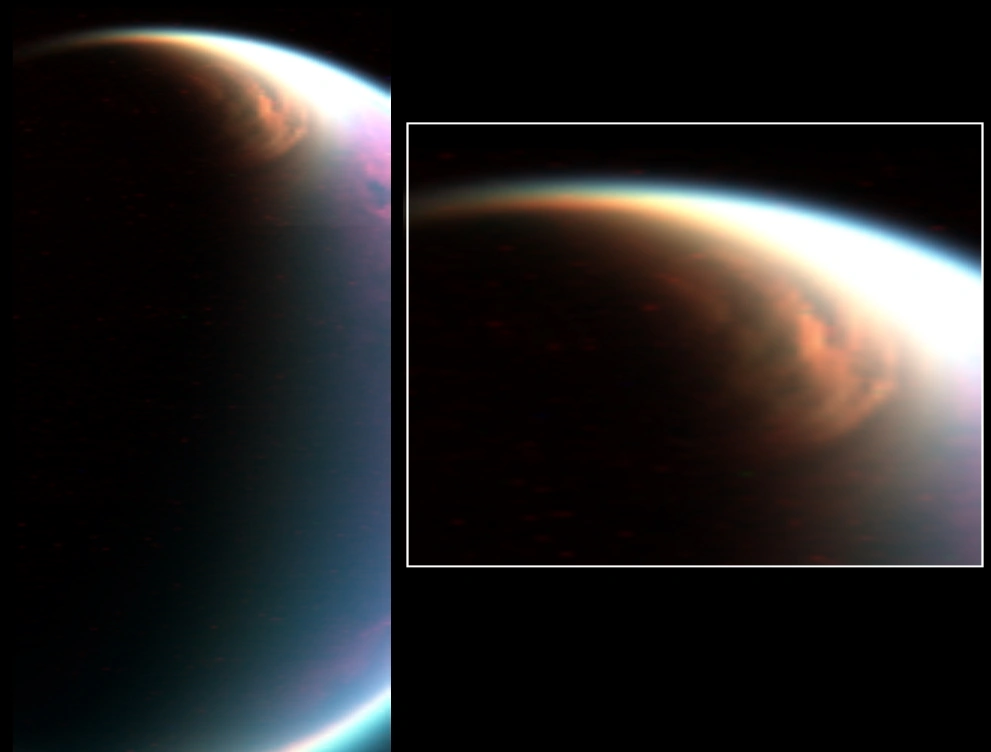

Atmospheric vortex on Titan's north pole (Cassini probe, 2006)
Climate
Seasons on Titan, like on Earth, switch. This is most noticeable in rains and lakes. Seasons change as Saturn and its satellites progress on their orbit around the Sun. Avearage temperature on Titan is around -180 *C, and barely differs on poles and equator.
Titan's upper atmosphere has a lot of methane, and its supposed to cause a greenhouse effect and heat up Titan, but orange fog from organic molecules in the lower layers of the atmosphere consumes solar radiation, causing an anti-greenhouse effect, cooling down Titan by around 10 degrees.
Methane condenses into clouds at a height of around several dozens of kilometers. Methane's humidity rises from 45% on surface to 100% on 8 km height. 8-16 km is a very sparse layer of clouds, a light drizzle constantly falls from them but is compensated by evaporation.
A gigantic cloud (2400 km across) was found in September 2006 40 km above the surface of Titan. While methane clouds do form, this one was more likely ethane, because of a tiny size of particles and because ethane condenses on such heights. It later turned out to consist of methane, ethane and one other organic compound. Scientists suppose that there was a methane-ethane rain or snow above that area at the time.
Clouds were found on southern pole of Titan too. They usually cover 1% of surface, but that can reach 8%. Its suggested that this happened because it was summer on southern pole at the time, that meant an intense heating of atmospheric masses, ascending currents, convection. In such conditions ethane cant condense into clouds even at 100% humidity. Rains happen on Titan's equator too.
Observations show that the height and persistence of clouds depend on latitude. Thus, at high latitudes (60° and above) persistent clouds, formed above the troposphere, are common at winter. At lower latitudes, clouds are found at an altitude of 15–18 km, are small in size and intermittent. At summer clouds form primarily around 40° latitude and are usually short-lived.
During 30 year rotation around the Sun, clouds first appear for 25 years, disappear for 4-5, and then begin appearing again.
Surface
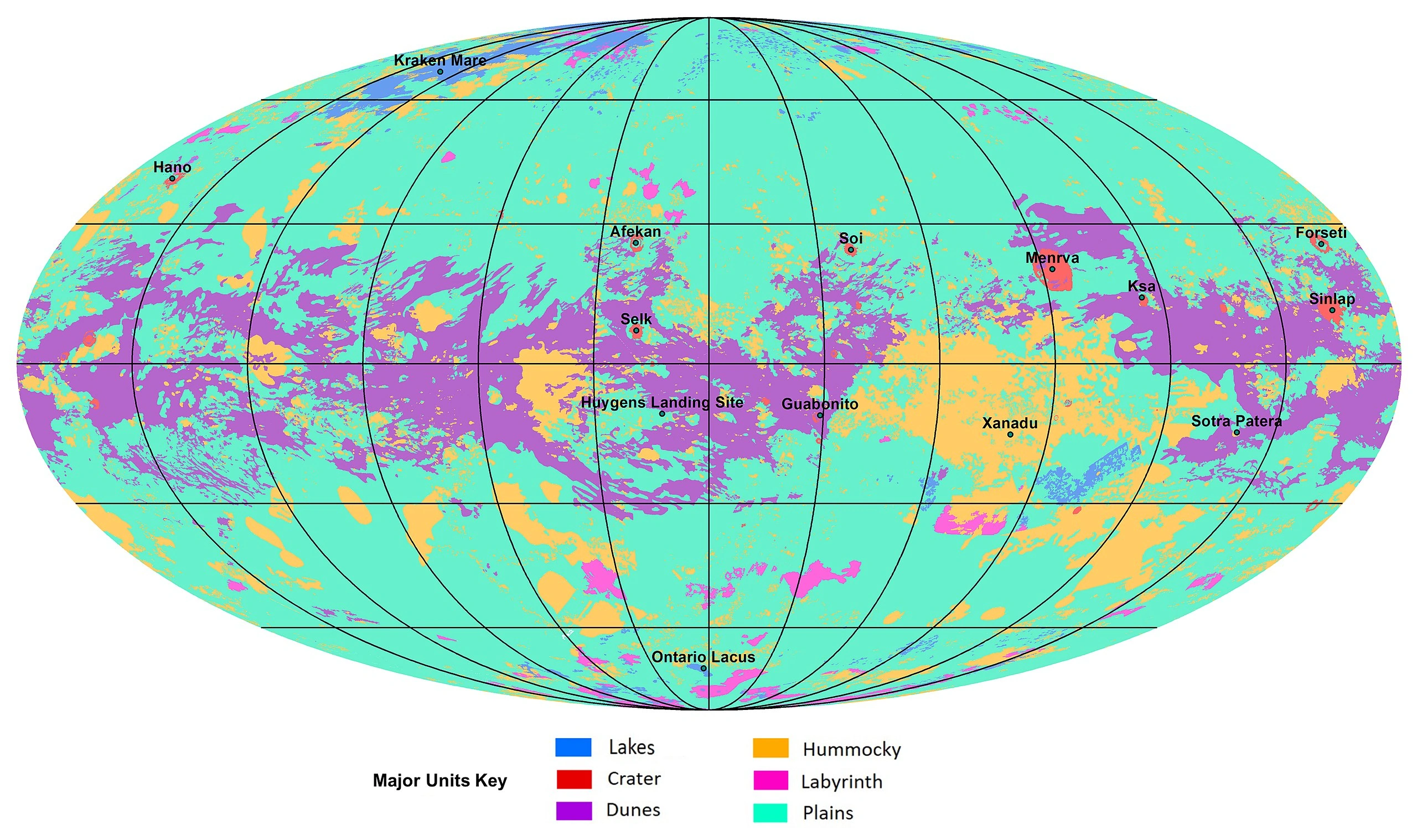

Map of Titan
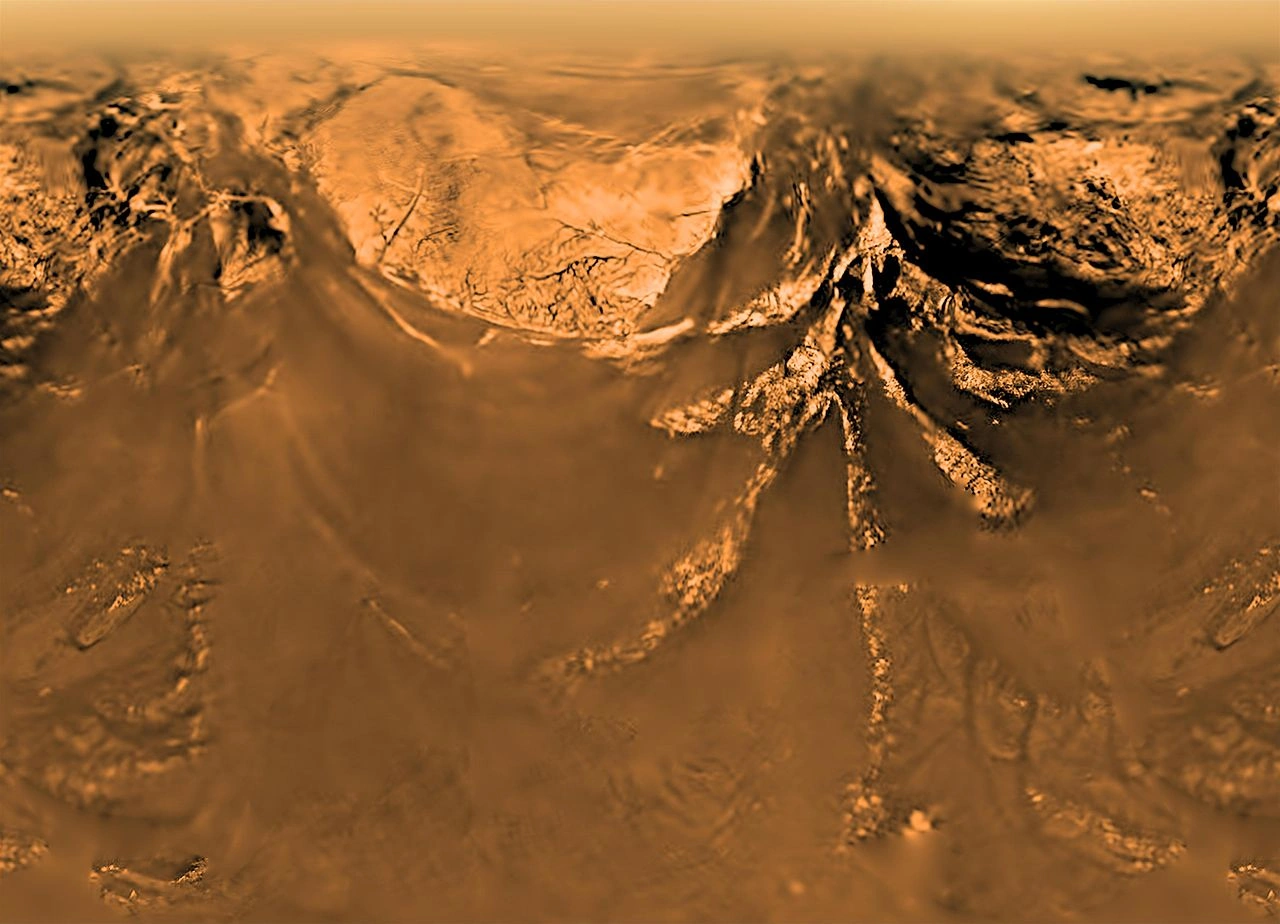

Mountains on Titan from a 10 km height
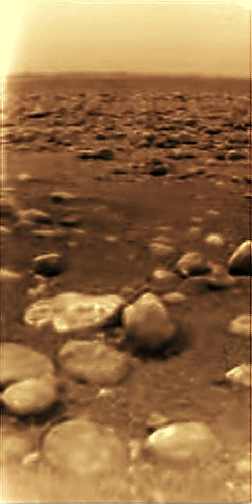

Titan terrain in the place where Huygens probe landed
Titan's surface in low altitudes is separated into several high and low albedo regions with clear borders. There is a light region the size of Australia on the leading hemisphere which got the name Xanadu. South-west of Xanadu there is a mysterious formation called Hotei Arcus, a bright arc. Whether its a hot volcanic region or a deposition of something (for example carbon dioxide) is not known.
Extended chains of mountains (or hills) up to several hundred meters high were found on the Adiri region. The southern hemisphere might have a massive mountain range up to 150 km across and 1.6 km in height. The laregst mountain on Titan is in Mithrim Montes and has a height of 3337 meters. There are bright sediments on tops of the hills, likely methane or other organics.
Overall Titan is very flat, with the variations in height below 2 km, however locally there can be extreme changes in height, and steep slopes are not rare, this is because of intensive erosion with the help of liquids and winds.
Titan does not have much craters, 7 are known for sure and 52 are hypothesized. This is because of wind erosion and fallout quickly covering them. Titan's surface is much less contrast in temperate latitudes.
Dunes
There are dark regions simillar to Xanadu by size on the moon's equator. They were initially thought to be methane seas, however radar explorations showed that the dark equatorial regions are almost everywhere covered by long parallel rows of dunes, stretching from west to east for hundreds of kilometers, they are also called "cat scratches"
The black color is explained by a lot of hydrocarbon dust there. The hydrocarbon dust falls from high layers of the atmosphere, gets washed away from hills by methane rains and is brought there by winds. It can also be mixed with ice sand.
Methane lakes and rivers
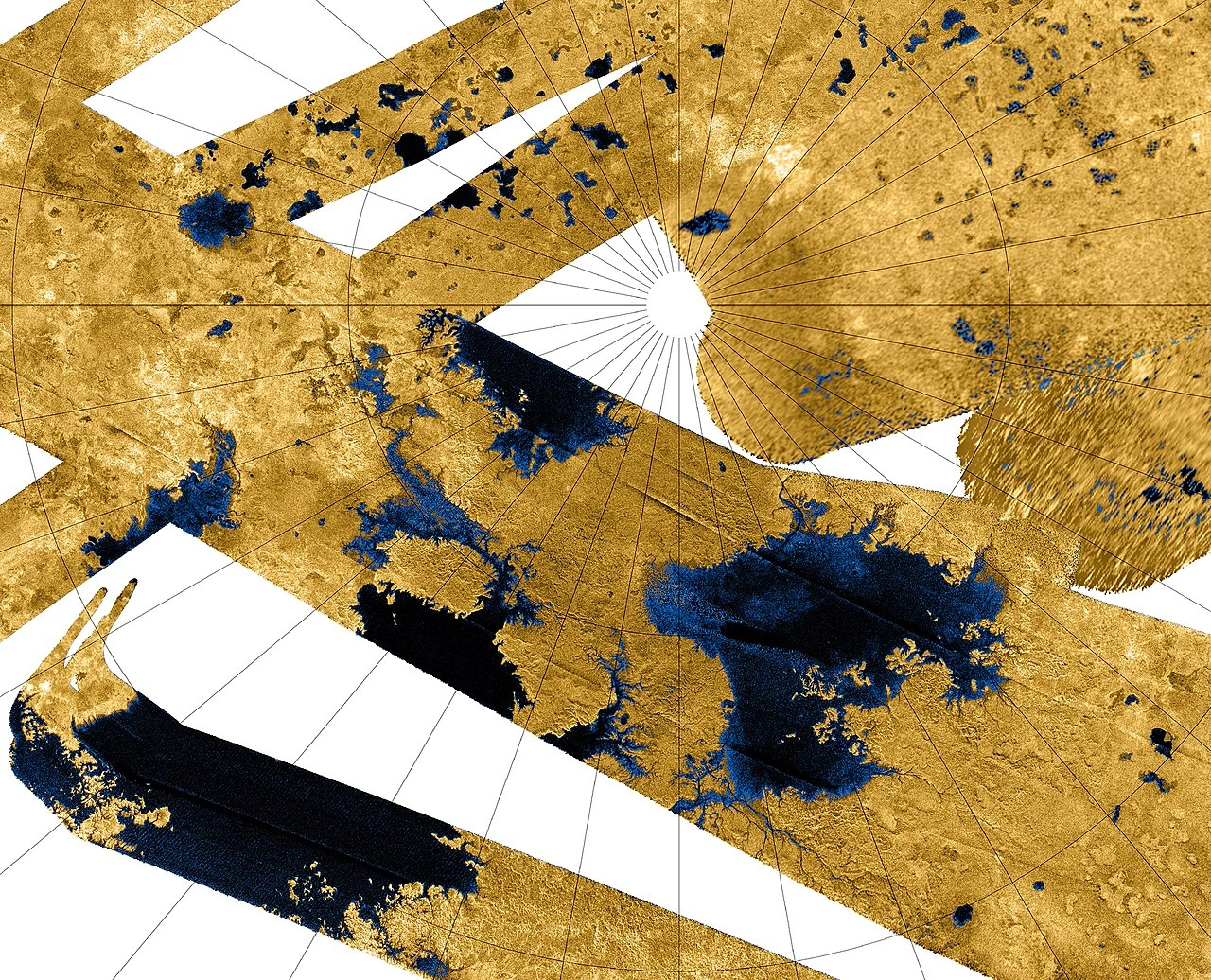

Image of lakes and seas on Titan's North Pole by Cassini
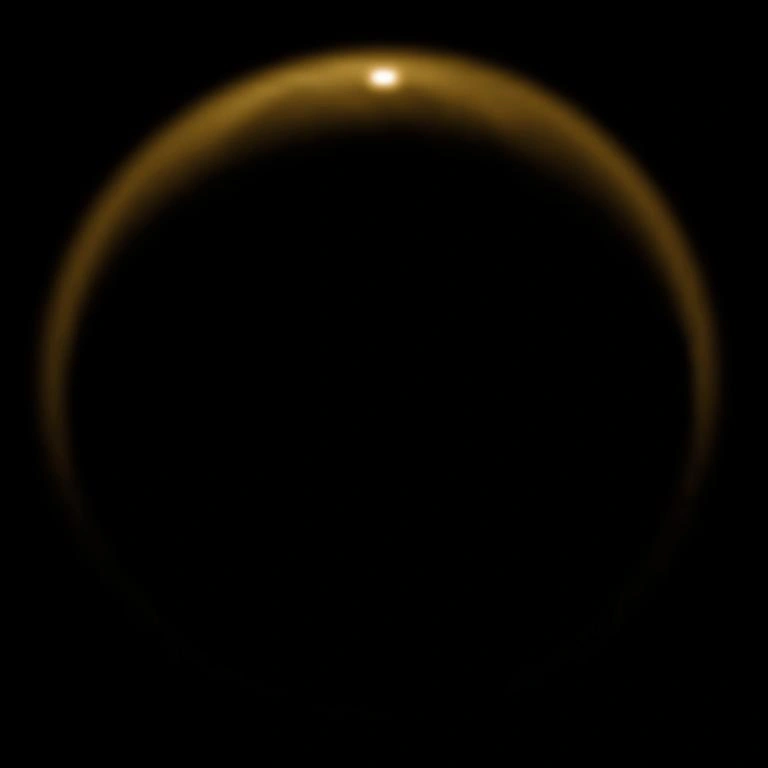

A lake reflecting sunlight
The possibility of liquid methane lakes and rivers on Titan was first suggested by data from Voyager-1 and Voyager-2, which showed all conditions needed for liquid methane. In 1995 Hubble Space Telescope and other data let us suppose the existence of methane lakes and even entire oceans. Cassini mission in 2004 also confirmed this, although not immedietaly. When it first arrived in Saturn system researchers hoped to find it by reflecting sunlight, but that failed. Direct proof appeared in July 2009, when a sunlight reflection in infared light was detected.
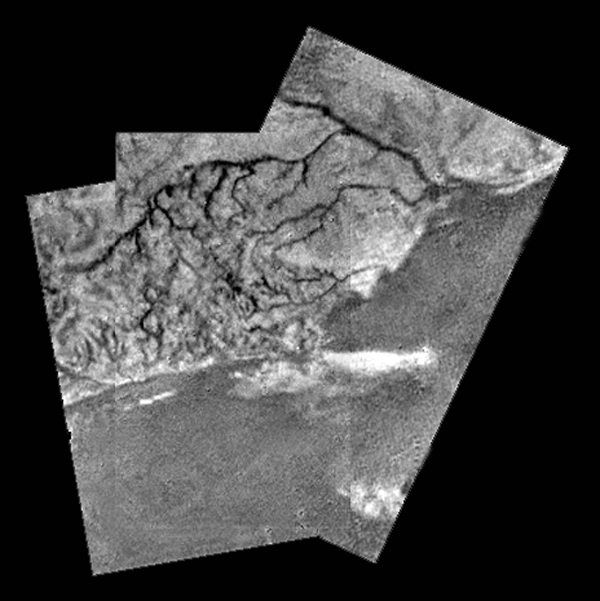

River beds on Titan
Cassini spacecraft earlier observed very smooth and/or highly absorbing surfaces near the poles, which turned out to be the long-doubted liquid methane or methane-ethane reservoirs. A dark well-defined feature in the south polar region was found in June 2005, which was a liquid lake later named Lake Ontario. Radar coverage of the Mezzoramia region at high latitudes in the Southern Hemisphere has showed a developed river system, coastline with characteristic traces of erosion, surface covered by liquid either currently or in the recent past.
Several huge lakes were found in the Northern Hemisphere in March 2007. Kraken Mare, the largest of them, reaches 1000 km in length and is comparable to the Caspian Sea. Another one is called Ligeia is 100 000 km2 in area and larger than any freshwater lakes on Earth.
The liquid bodies on Titan are 76-79% ethane, 7-8% propane, 5-10% methane, 2-3% hydrogen cyanide and 1% other organic compounds.
Titan has several times more hydrocarbons than Earth has oil and gas. The surfaces of lakes can have swimming ice pieces, such ice would need to be saturated with gas to not drown.
The majority of lakes are in the northern polar region of Titan, while the southern barely has any. Possibly because of season changes, with each season being 7 years, all liquid methane can dry up from one hemisphere and be moved to the other by winds and rains.
Internal structure and geology
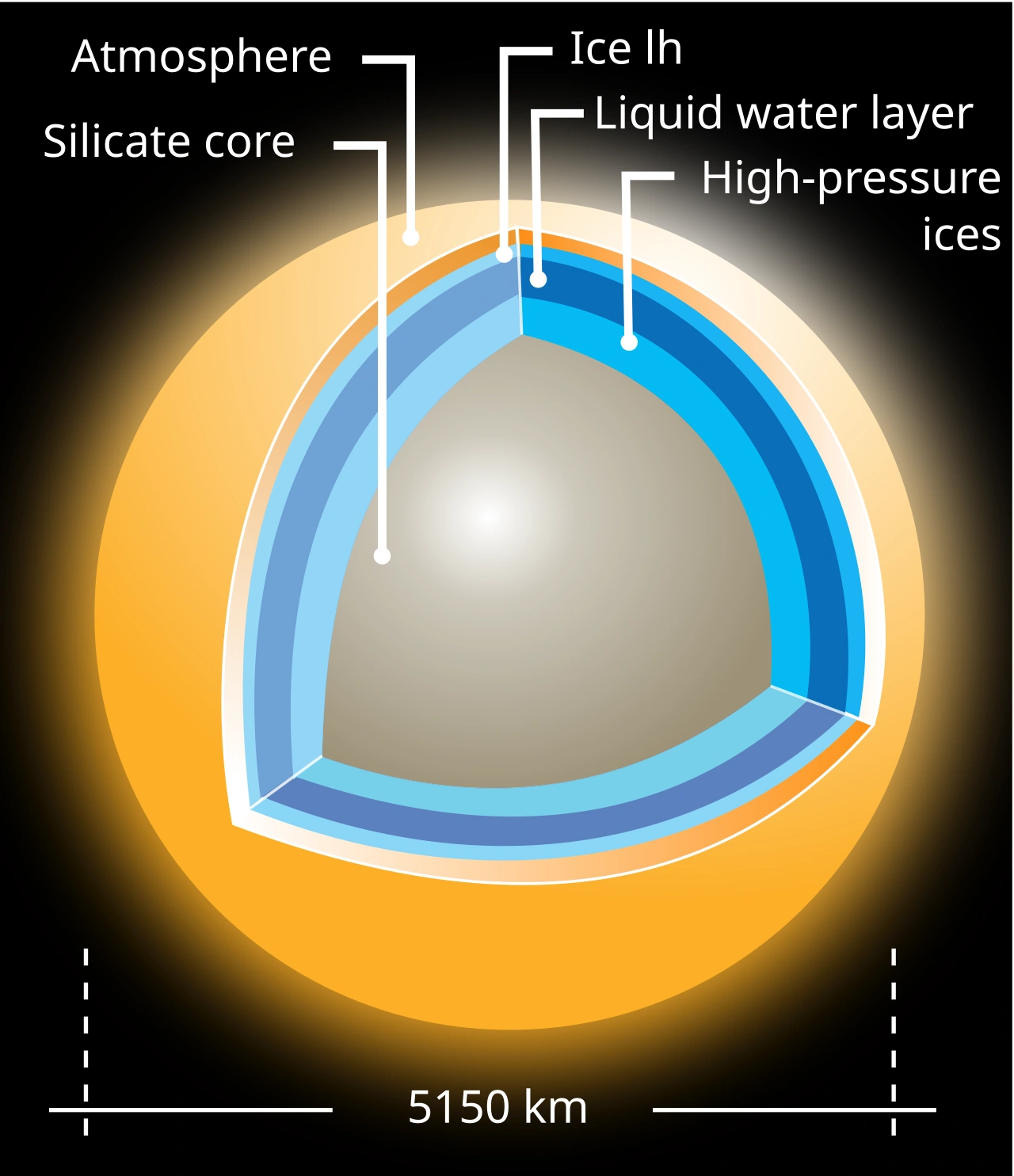

Titan consists about 50% of water ice and 50% from rocks. Its comparable to some other large satellites of gas giants: Ganymede, Europa, Callisto, Triton, but is very different from them by composition and atmosphere.
Titan has a solid core around 3400 km in diameter surrounded by several layers of water ice. Outer layers of Titan's mantle are made of water ice and methane hydrates, the inner from very pressed and dense ice. A layer of liquid water can exist inbetween these two.
Like other satellites of Jupiter and Saturn such as Io or Enceladus Titan is affected by very strong tidal forces from its planet, which play a significant role in the satellite's inner processes, heating up its core and supporting volcanic activity.
Subsurface ocean
Titan is thought to have a water subsurface ocean at a depth of around 100 km. Its water is very dense and very salty, its most likely a brine including various salts from sodium, potassium and sulfur. The ocean depth also varies in different places on the satellite. The high saltyness means life as we know it cant really exist there.
Titan's surface features shifted 30 km between 2005 and 2007. This could happen because of a liquid layer separating Titan's surface from core.
Titan's waters in this subsurface ocean can be made 10% from ammonia. The ammonia as an antifreeze and doesnt let the ocean freeze together with tidal forces from Saturn.
Volcanism
.png.png)
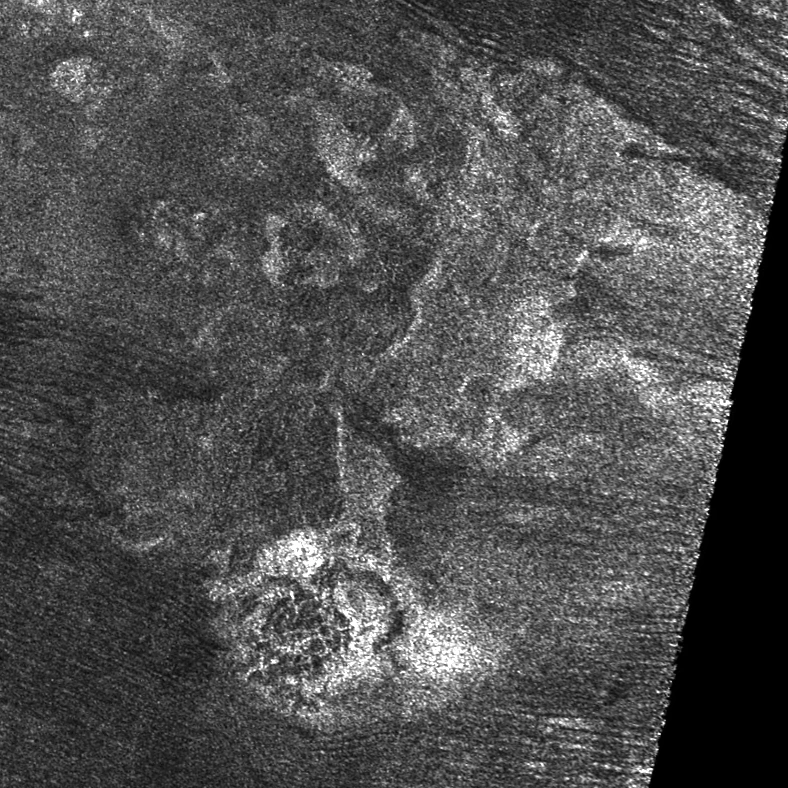
A possible volcano on Titan
Titan has signs of volcanic activity. However, these are not silicate volcanoes, like on Earth, Mars and Venus, but the so-called cryovolcanos. They likely spew out a water-ammonia mixture with a bit of hydrocarbons.
Volcanism was first suggested when argon-40, which forms from decay of radioactive substances, in Titan's atmosphere. Later Cassini spacecraft detected a powerful source of methane, which is possibly a cryovolcano. Because no source of methane which can support the permanent amount of this element in the satellite's atmosphere was found, most of it is thought to come from cryovolcanoes.
Two bright temporary formations were found on Titan in December 2008, and while they were temporary, they lasted too long to be some weather event. Its suggested to be caused by a cryovolcano eruption.
Like on Earth, volcanism on Titan is caused by decay of radioactive elements in the object's mantle. Earth's magma is made from molten rocks with a smaller density than that of rocks through which they erupt, in Titan on the other hand this water-ammonia mixture is much denser than water ice it gets thru, therefore volcanism needs much more energy, and a source of such energy is tidal forces from Saturn.
Exploration
Titan's exploration went very slowly before 1979. Atmosphere of Titan was discovered in winter 1943-1944 by Gerard Kuiper. Titan's apparent magnitude is +7.9, invisible to the naked eye, but easy to see with binoculars or amateur telescopes.
Pioneer-11 and Voyagers
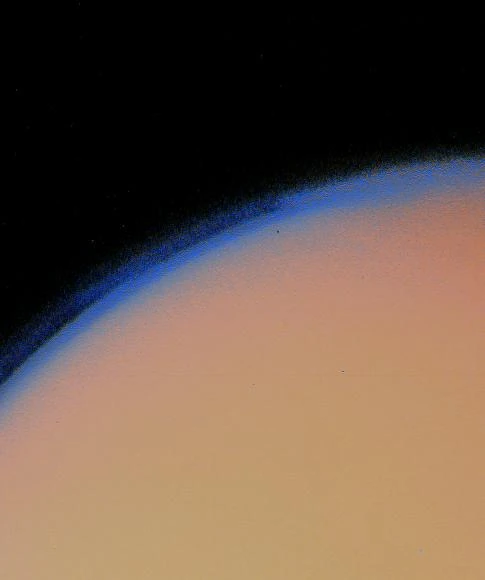

Titan's atmosphere by Voyager-1, 1980
First spacecraft to come close to Titan was Pioneer-11 in 1979. It sent back five images of Titan on September 1, 1979. The probe's data showed surface temperature of Titan is too low for existence of life. Pioneer-11 flew past Titan around 350 000 km away, the images were too blurry to see any details.
Voyager-1 flew past Titan only 5600 km away on November 12, 1980, but atmosphere haze didnt let us see any details on the surface. Voyager-1 only studied the composition of Titan's atmosphere and its basic parameters like size or mass, and also clarified orbital period.
Voyager-2 flew past Saturn system on August 25, 1981. The probe was sent to Uranus and visited Saturn for a gravitational maneuver, Titan was barely studied at all.
Hubble Space Telescope
First images to shed light on Titan's surface structure were taken by Hubble Space Telescope in 1990s. The infrared images showed organic smog and methane clouds. A clear contrast of dark and bright spots on Titan's surface is very different from other simillar satellites in the Solar System. Hubble also didnt find any craters, which are common for most satellites.
Cassini probe
On October 15, 1997 the Cassini-Huygens probe flied up from Cape Canaveral, a joint project of several space agencies. It was created to study the Saturn satellite system and Titan in particular. Cassini became the first ever artifical satellite of Saturn, initially the mission was thought to be for 4 years.
Cassini was on Saturn's orbit from July 1, 2004. Just as planned, the first flyby by Titan happened on October 26, 2004 only 1200 km away. Radio images by Cassini show a complex structure of Titan's surface.
Cassini flew past Titan 21 times between July 22, 2006 and May 28, 2008, with the minimum distance being only 950 km. Lakes on Titan were prooved using images from there.
The mission was first extended to 2010 (21 additional flyby) and then to 2017 (56 more). The mission ended on September 15, 2017, when Cassini burned in Saturn's atmosphere.
Huygens probe
This section is being written
Huygens separated from Cassini on December 25, 2004, and landed on Titan's surface on January 14, 2005. Landing on the surface with parachutes took it 2 hours, 27 minutes and 50 seconds. It collided with Titan's surface with a speed of 16 km/h. The instruments experienced short-term overloads 15 times greater than the acceleration of gravity on Earth.
Future missions
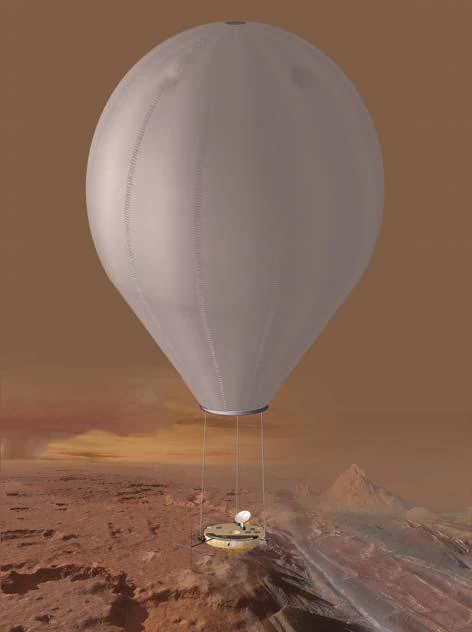

The balloon proposed for the Titan Saturn System Mission
The Titan Saturn System Mission (TSSM) is a joint NASA/ESA proposal for exploration of Saturn's moons.[1] It envisions a hot-air balloon to float in the moon's atmosphere for six months. It was competing against the Europa Jupiter System Mission (EJSM) proposal for funding. In February 2009 it was announced that ESA/NASA had given the EJSM mission priority ahead of the TSSM,[2] although TSSM was still considered for a later launch date. Since NASA's departure from the program in 2012, these plans were put on hold.
There has also been a proposal for a Titan Mare Explorer (TiME), which would be a low-cost lander that would splash down in a lake near Titan's north pole and float on the surface of the lake for 3 to 6 months. It could launch as early as 2016 and arrive in 2023.[3][4][5] In 2012, however, NASA chose to fund the Mars probe InSight instead of TiME, rendering the Titan probe's future uncertain.
Another lake lander project was proposed in late 2012 in Europe. The concept probe is called Titan Lake In-situ Sampling Propelled Explorer (TALISE).[6][7] The major difference with the TiME probe would be a propulsion system.
Another proposed mission to Titan is the Aerial Vehicle for In-situ and Airborne Titan Reconnaissance (AVIATR), which is an unmanned plane (or drone) which would fly through Titan's atmosphere and take High definition images of the surface of Titan. [8][9][10]
Prebiotic conditions and search for life
- Main article: Life on Titan
- See also: Planetary habitability
While the Cassini–Huygens mission was not equipped to provide evidence for biosignatures or complex organic compounds, it showed an environment on Titan that is similar, in some ways, to ones theorized for the primordial Earth.[11] Scientists surmise that the atmosphere of early Earth was similar in composition to the current atmosphere on Titan, with the important exception of a lack of water vapor on Titan.[12] The satellite is thought by some scientists as a possible host for microbial extraterrestrial life or, at least, as a prebiotic environment rich in complex organic compounds.
Formation of complex molecules
The Miller–Urey experiment and several following experiments have shown that with an atmosphere similar to that of Titan and the addition of UV radiation, complex molecules and polymer substances like tholins can be generated. The reaction starts with dissociation of nitrogen and methane, forming hydrogen cyanide and acetylene. Further reactions have been studied extensively.[13]
In October 2010, Sarah Horst of the University of Arizona reported finding the five nucleotide bases—building blocks of DNA and RNA—among the many compounds produced when energy was applied to a combination of gases like those in Titan's atmosphere. Horst also found amino acids, the building blocks of protein. She said it was the first time nucleotide bases and amino acids had been found in such an experiment without liquid water being present.[14]
Possible subsurface habitats
Laboratory simulations have led to the suggestion that enough organic material exists on Titan to start a chemical evolution analogous to what is thought to have started life on Earth. While the analogy assumes the presence of liquid water for longer periods than is currently observable, several theories suggest that liquid water from an impact could be preserved under a frozen isolation layer.[15] It has also been observed that liquid ammonia oceans could exist deep below the surface;[16][17] one model suggests an ammonia–water solution as much as 200 km deep beneath a water ice crust, conditions that, "while extreme by terrestrial standards, are such that life could indeed survive".[18] Heat transfer between the interior and upper layers would be critical in sustaining any sub-surface oceanic life.[16] Detection of microbial life on Titan would depend on its biogenic effects. That the atmospheric methane and nitrogen might be of biological origin has been examined, for example.[18]
Methane and life at the surface
- See also: Hypothetical types of biochemistry
It has been suggested that life could exist in the lakes of liquid methane on Titan, just as organisms on Earth live in water.[19] Such creatures would inhale H2 in place of O2, metabolize it with acetylene instead of glucose, and exhale methane instead of carbon dioxide.[19][20]
Although all living things on Earth (including methanogens) use liquid water as a solvent, it is speculated that life on Titan might instead use a liquid hydrocarbon, such as methane or ethane.[21] Water is a stronger solvent than methane.[22] However, water is also more chemically reactive, and can break down large organic molecules through hydrolysis.[21] A life-form whose solvent was a hydrocarbon would not face the risk of its biomolecules being destroyed in this way.[21]
In 2005, astrobiologist Chris McKay argued that if methanogenic life did exist on the surface of Titan, it would likely have a measurable effect on the mixing ratio in the Titan troposphere: levels of hydrogen and acetylene would be measurably lower than otherwise expected.[19]
In 2010, Darrell Strobel, from Johns Hopkins University, identified a greater abundance of molecular hydrogen in the upper atmospheric layers of Titan compared to the lower layers, arguing for a downward flow at a rate of roughly 1025 molecules per second and disappearance of hydrogen near Titan's surface; as Strobel noted, his findings were in line with the effects Chris McKay had predicted if methanogenic life-forms were present.[19][22][23] The same year, another study showed low levels of acetylene on Titan's surface, which were interpreted by Chris McKay as consistent with the hypothesis of organisms consuming hydrocarbons.[22] While restating the biological hypothesis, McKay cautioned that other explanations for the hydrogen and acetylene findings are more likely: the possibilities of yet unidentified physical or chemical processes (e.g., a surface catalyst accepting hydrocarbon or hydrogen), or flaws in the current models of material flow.[24] Composition data and transport models need to be substantiated, and, per Occam's razor, a physical or chemical explanation is preferred a priori over one of biology (given the simplicity of chemical catalysts versus the complexity of biological forms). Even so, McKay notes that discovery of either, including simply of a catalyst effective at 69, would be an important discovery.[25]
As NASA notes in its news article on the June 2010 findings: "To date, methane-based life forms are only hypothetical. Scientists have not yet detected this form of life anywhere".[22] As the NASA statement also says: "some scientists believe these chemical signatures bolster the argument for a primitive, exotic form of life or precursor to life on Titan's surface."[22]
Obstacles
Despite these biological possibilities, there are formidable obstacles to life on Titan, and any analogy to Earth is inexact. At a vast distance from the Sun, Titan is frigid (a fact exacerbated by the anti-greenhouse effect of its cloud cover), and its atmosphere lacks CO2. Because of these difficulties, scientists such as Jonathan Lunine have viewed Titan less as a likely habitat for life, than as an experiment for examining theories on the conditions that prevailed prior to the appearance of life on Earth.[26] While life itself may not exist, the prebiotic conditions of the Titanian environment and the associated organic chemistry remain of great interest in understanding the early history of the terrestrial biosphere.[11] Using Titan as a prebiotic experiment involves not only observation through spacecraft, but laboratory experiment, and chemical and photochemical modeling on Earth.[13]
Panspermia hypothesis
It is hypothesized that large asteroid and cometary impacts on Earth's surface may have caused fragments of microbe-laden rock to escape Earth's gravity, suggesting the possibility of transpermia. Calculations indicate that a number of these would encounter many of the bodies in the Solar System, including Titan.[27][28] On the other hand, Jonathan Lunine has argued that any living things in Titan's cryogenic hydrocarbon lakes would need to be so different chemically from Earth life that it would not be possible for one to be the ancestor of the other.[29]
Future conditions
Conditions on Titan could become far more habitable in the far future. Five billion years from now, as the Sun becomes a red giant, surface temperatures could rise enough for Titan to support liquid water on its surface making it habitable.[30] As the Sun's ultraviolet output decreases, the haze in Titan's upper atmosphere will be depleted, lessening the anti-greenhouse effect on the surface and enabling the greenhouse created by atmospheric methane to play a far greater role. These conditions together could create a habitable environment, and could persist for several hundred million years. This was sufficient time for simple life to evolve on Earth, although the presence of ammonia on Titan would cause chemical reactions to proceed more slowly.[31]
See also
Template:Portal
- Colonization of Titan
- Life on Titan
- Lakes of Titan
- Saturn's moons in fiction
- Titan in fiction
Titan is possible canditate for harbouring life.
References
- ↑ Mission Summary: TANDEM/TSSM Titan and Enceladus Mission. ESA (2009). Retrieved on 2009-01-30.
- ↑ Rincon, Paul, "Jupiter in space agencies' sights", February 18, 2009.
- ↑ Stofan, Ellen (2010). TiME: Titan Mare Explorer (PDF). Caltech. Retrieved on 2011-08-17.
- ↑ Kate Taylor, "NASA picks project shortlist for next Discovery mission", TG Daily, 9 May 2011. Retrieved on 2011-05-20.
- ↑ Greenfieldboyce, Nell, "Exploring A Moon By Boat", National Public Radio (NPR), September 16, 2009. Retrieved on 2009-11-08.
- ↑ Script error: No such module "citation/CS1".
- ↑ Elizabeth Landau, "Probe would set sail on a Saturn moon", CNN – Light Years, 9 October 2012. Retrieved on 2012-10-10.
- ↑ AVIATR: An Airplane Mission for Titan. Universetoday.com (2012-1-2). Retrieved on 2013-02-26.
- ↑ Soaring on Titan: Drone designed to scout Saturn's moon. nbcnews.com (2012-1-10). Retrieved on 2013-02-26.
- ↑ The plane built to soar above the clouds - on Saturn's mysterious moon Titan. Daliymail.co.uk (2012-1-4). Retrieved on 2013-02-26.
- ↑ 11.0 11.1 Raulin, F. (2005). "Exo-astrobiological aspects of Europa and Titan: From observations to speculations". Space Science Review 116 (1–2): 471–487. DOI:10.1007/s11214-005-1967-x.
- ↑ Staff. "Lakes on Saturn's Moon Titan Filled With Liquid Hydrocarbons Like Ethane and Methane, Not Water", ScienceDaily, October 4, 2010. Retrieved on 2010-10-05.
- ↑ 13.0 13.1 Raulin F., Owen T. (2002). "Organic chemistry and exobiology on Titan". Space Science Review 104 (1–2): 377–394. DOI:10.1023/A:1023636623006.
- ↑ Staff. "Titan's haze may hold ingredients for life", Astronomy, October 8, 2010. Retrieved on 2010-10-14.
- ↑ Artemivia N., Lunine J, (2003). "Cratering on Titan: impact melt, ejecta, and the fate of surface organics". Icarus 164 (2): 471–480. DOI:10.1016/S0019-1035(03)00148-9.
- ↑ 16.0 16.1 Grasset, O.; Sotin, C.; Deschamps, F. (2000). "On the internal structure and dynamic of Titan". Planetary and Space Science 48 (7–8): 617–636. DOI:10.1016/S0032-0633(00)00039-8.
- ↑ Lovett, Richard A. (March 20, 2008). Saturn Moon Titan May Have Underground Ocean, National Geographic
- ↑ 18.0 18.1 Fortes, A. D. (2000). "Exobiological implications of a possible ammonia-water ocean inside Titan". Icarus 146 (2): 444–452. DOI:10.1006/icar.2000.6400.
- ↑ 19.0 19.1 19.2 19.3 McKay, C. P.; Smith, H. D. (2005). "Possibilities for methanogenic life in liquid methane on the surface of Titan". Icarus 178 (1): 274–276. DOI:10.1016/j.icarus.2005.05.018.
- ↑ Chris McKay, "Have We Discovered Evidence For Life On Titan", Space Daily, June 8, 2010. Retrieved on 2012-03-15.
- ↑ 21.0 21.1 21.2 Committee on the Limits of Organic Life in Planetary Systems, Committee on the Origins and Evolution of Life, National Research Council; The Limits of Organic Life in Planetary Systems; The National Academies Press, 2007; page 74.
- ↑ 22.0 22.1 22.2 22.3 22.4 What is Consuming Hydrogen and Acetylene on Titan?. NASA/JPL (2010). Retrieved on 2010-06-06.
- ↑ Strobel, Darrell F. (2010). "Molecular hydrogen in Titan's atmosphere: Implications of the measured tropospheric and thermospheric mole fractions". Icarus 208 (2): 878–886. DOI:10.1016/j.icarus.2010.03.003.
- ↑ Mckay, Chris (2010). Have We Discovered Evidence For Life On Titan. SpaceDaily. Retrieved on 2010-06-10.
- ↑ McKay, Chris (2010). Have We Discovered Evidence For Life On Titan. SpaceDaily. Retrieved on 2010-06-10. Space.com. March 23, 2010.
- ↑ Saturn's Moon Titan: Prebiotic Laboratory. Astrobiology Magazine (August 11, 2004). Archived from the original on August 28, 2004. Retrieved on 2004-08-11.
- ↑ "Earth could seed Titan with life", BBC News, March 18, 2006. Retrieved on 2007-03-10.
- ↑ Gladman, Brett; Dones, Luke; Levinson, Harold F.; Burns, Joseph A. (2005). "Impact Seeding and Reseeding in the Inner Solar System". Astrobiology 5 (4): 483–496. DOI:10.1089/ast.2005.5.483.
- ↑ Lunine, Jonathan (2008). "Saturn's Titan: A Strict Test for Life's Cosmic Ubiquity". Proceedings of the American Philosophical Society 153 (4). copy at archive.org
- ↑ The National Air and Space Museum (2012). Climate Change in the Solar System. Retrieved on 2012-01-14.
- ↑ Lorenz, Ralph D.; Lunine, Jonathan I. and McKay, Christopher P. (1997). Titan under a red giant sun: A new kind of "habitable" moon. NASA Ames Research Center, Lunar and Planetary Laboratory, Department of Planetary Sciences, University of Arizona. Retrieved on 2008-03-21.
Bibliography
- Coustenis, Athéna and Taylor, F. W. (2008). Titan: Exploring an Earthlike World. World Scientific.
Further reading
Template:Commons category
- Lorenz, Ralph; Jacqueline Mitton (2002). Lifting Titan's Veil: Exploring the Giant Moon of Saturn. Cambridge University Press.
External links
- Cassini–Huygens Mission To Saturn & Titan. Multimedia Feature Titan Virtual Tour
- Titan Profile at NASA's Solar System Exploration site
- Video of Huygens’ descent from the ESA
- Cassini Imaging Central Laboratory for Operations (CICLOPS) site Titan image search
- European Space Agency. (2005). ESA—Cassini-Huygens. Retrieved March 28, 2005.
- The Planetary Society (2005). TPS: Saturn's moon Titan. Retrieved March 28, 2005.
- University of Arizona Lunar and Planetary Lab (2005). Lunar and Planetary Lab The Descent Imager-Spectral Radiometer of the Cassini–Huygens Mission to Titan. Retrieved March 28, 2005.
- The Alien Noise. This recording is a laboratory reconstruction of the sounds heard by Huygens' microphones.
- Movie of Titan's rotation from the National Oceanic and Atmospheric Administration site
- AstronomyCast: Titan Fraser Cain and Pamela Gay, 2010.
- Titan nomenclature and Titan map with feature names from the USGS planetary nomenclature page