Sirius System
Sirius System is a binary system of a White main sequence star and a White Dwarf. component A is the brightest star from Earth with the spectral class A. while component B is the nearest white dwarf to Earth and a famous one.
Sirius A
Sirius A, also known as Alpha Canis Majoris, is the main component of the Sirius star system. It is a main sequence star of spectral type A1V, which means it is a white or bluish-white star with a relatively high surface temperature. Its luminosity is about 25 times that of the Sun, making it one of the brightest stars in the night sky. Sirius A is visible from Earth to the naked eye and plays an important role in mythology and historical navigation.
History and Future
Sirius A is a main sequence star, which means it is in a relatively stable phase of nuclear fusion in its core, where hydrogen is converted into helium. As a star of spectral type A1V, Sirius A is a white or bluish-white star with a relatively high surface temperature. Over billions of years, Sirius A will continue to burn its reserve of hydrogen in the core. Eventually, when the hydrogen runs out, the star will begin to evolve. Initially, it will expand to become a Red giant, increasing significantly in size and luminosity. During this phase, it is possible for Sirius A to swallow its companion, Sirius B, as it expands. After the red giant phase, Sirius A will eventually lose its outer layers, creating a planetary nebula, and the remaining core will contract to form a white dwarf. The resulting white dwarf will be extremely dense and compact, composed mainly of carbon and oxygen. The stellar evolution of Sirius A will therefore follow the typical path for stars of similar mass, culminating in the formation of a white dwarf after its red giant phase. This process will occur over many billions of years, with Sirius A still in the main sequence phase.
Sirius B
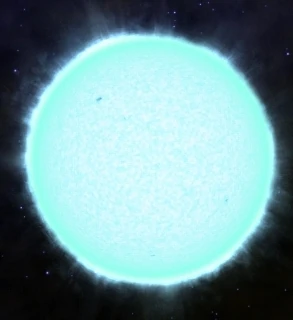

a representative image of what it would be like to sail nearby
Sirius B is a White dwarf, the remaining core of a Star that has already passed through the red giant phase and lost its outer layers. As a result, it is extremely dense and compact, composed mainly of carbon and oxygen. The evolutionary history of Sirius B began when it was a star similar to Sirius A. When it exhausted its supply of hydrogen in the core, it began to expand and become a red giant. During this phase, it lost its outer layers, creating a Planetary nebula, and the remaining core contracted to form the white dwarf. Currently, Sirius B orbits Sirius A in a very close orbit, which indicates that, during Sirius A's red giant phase, there was interaction between the two stars. In the future, as a white dwarf, Sirius B will continue to cool and decrease in luminosity over billions of years, eventually becoming a cool black White dwarf
Sirius B, also known as the Pup Star, is one of the most massive white dwarfs known. With a mass of 1.02 M☉, it is almost double the 0.5–0.6 M☉ average. This mass is packed into a volume roughly equal to the Earth's. The current surface temperature is 25,200 K. Because there is no internal heat source, Sirius B will steadily cool as the remaining heat is radiated into space over the next two billion years or so. A white dwarf forms after a star has evolved from the main sequence and then passed through a red giant stage. This occurred when Sirius B was less than half its current age, around 120 million years ago. The original star had an estimated 5 M☉ and was a B-type star (most likely B5V for 5 M☉) when it was still on the Main sequence, potentially burning around 600–1200 times more luminous than the sun. While it passed through the red giant stage, Sirius B may have enriched the Metallicity of its companion, explaining the very high metallicity of Sirius A.This star is primarily composed of a carbon–oxygen mixture that was generated by helium fusion in the progenitor star. This is overlaid by an envelope of lighter elements, with the materials segregated by mass because of the high surface gravity. The outer atmosphere of Sirius B is now almost pure hydrogen—the element with the lowest mass—and no other elements are seen in its spectrum.