Phobos is the second moon of Mars. This is one of the two moons of Mars, the other being Deimos.
Formation
Phobos is estimated to have formed around 4 billion years ago. There are multiple theories as to how it came about.
Giant Impact Hypothesis
This is the predominant theory amongst scientists. It dictates that around 4 billion years ago another celestial body, roughly 1/3rd the size of Mars, struck the planet[1]. The collision ejected debris so far that it passed the Roche limit and formed a ring around Mars. Over time the debris making up the ring clumped into multiple moons[1]. As of today Phobos and Deimos are the only survivors, with the rest of the moons having fallen back to within the Roche limit and been broken up.
Telescopic observations seem to corroborate this theory too, since Phobos appears to be made up of different materials than Mars.
Captured Asteroid Hypothesis
A slightly more outdated theory that was formerly the predominant idea. Scientists observed that the surface spectra of Phobos seemed to be consistent with D-Type or T-Type asteroids on behalf of its dark and reddish colour. Thus they thought that Phobos was an asteroid which had been captured by Mars and got locked into orbit.
However this theory is now disputed for several reasons. Phobos' orbit is nearly circular, and it lies on Mars' equator, which would not be the case for a captured asteroid[1]. Some mechanism would've had to alter the orbit to what it is currently.
In Situ Formation Hypothesis
This theory is similar in nature to the Giant Impact Hypothesis but with a few differences. Instead of a major impact, it posits that a celestial body came close enough to proto-Mars that it was pulled in. Once it passed the Roche limit it was torn apart and formed the aforementioned ring, which then became the moons[1].
This theory suffers from similar problems as the Captured Asteroid Hypothesis. There's no mechanism provided that could have propelled Phobos outwards to a mostly stable orbit[1].
Orbit
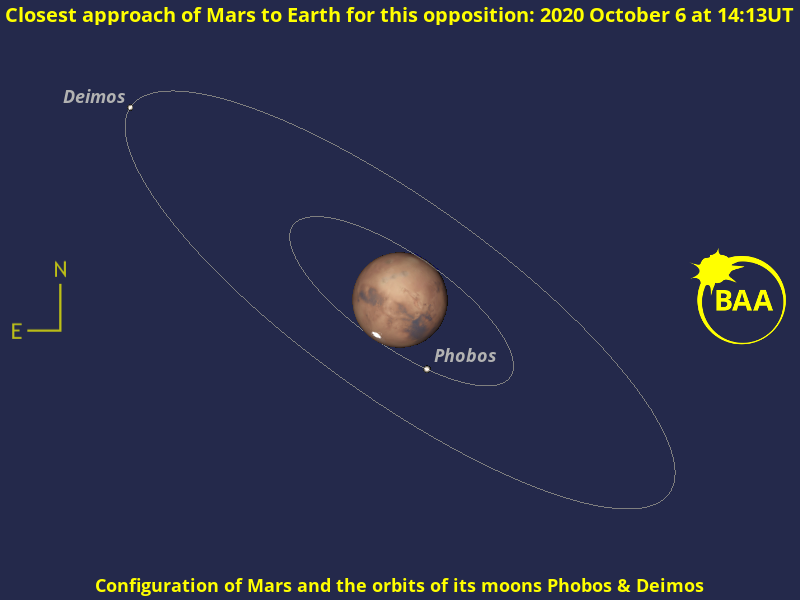

Phobos' position on 6th October 2020, 14:31.
Phobos is well known for its unstable and rapidly decaying orbit. Currently it orbits around Mars' equator, as previously mentioned, and it does so once every 7 hours and 39 minutes[2]. This means it rises and sets three times per sol (Martian day)[2]. From the surface of Mars it is a peculiar sight, since Phobos orbits faster than Mars spins, it rises in the west and sets in the east[2].
Phobos is also incredibly close to the surface of Mars. As of 2026 it sits at 5,989 kilometres from the surface[3], and every hundred years it grows 1.8 metres (6 feet) closer. Its proximity means that on some parts of Mars it cannot be seen at certain parts of the day[2].
It is estimated that, due to the orbital decay, Phobos will either collide with Mars or break up into a ring again around 50 million years from now[2].
Atmosphere
Phobos has no atmosphere because it does not generate enough gravity to accumulate gas molecules.
Composition
Phobos is notable for its irregular, almost potato-like, shape. It takes on this shape because it is not large enough to generate the gravity required to shape itself into a sphere. Deimos shares this odd appearance.
The moon is made up of C-Type Rock, like blackish Carbonaceous Chondrite asteroids. Over time its surface has been crushed down into a powder from repeated meteor impacts.
Discovery & Exploration
Early Speculation
Galileo Galilei (1564 - 1642) pointed his telescope at Mars in 1609, but it was nowhere near powerful enough to observe either of the moons due to their size. However, Johannes Kepler (1571 - 1630) began to speculate about their potential existence. He believed that since Venus had no moons, Earth had one, and at the time Galileo had recently discovered the first four moons of Jupiter, Mars must have two to maintain the "harmony"[4]. This idea, although flawed since Jupiter is known to have 115 moons as of April 2026, was correct as a guess.
Even as telescopes improved and Mars was observed in greater detail, they were still incapable of viewing either moon. The existence of both remained purely speculation.
Discovery
In Summer 1877, Mars came into opposition with Earth, which sparked a wave of scientific investigations into the planet. In particular Asaph Hall (1829 - 1907) wanted to prove that Mars did have its own satellites. Hall worked from the United States Naval Observatory in the "Foggy Bottom" neighbourhood in Washington D.C. Specifically he used the "Great Equatorial" telescope[5]. At the time this telescope, measuring 66cm (26 inches), was the largest in the world. The search did not get off to a good start. The weather conditions at Foggy Bottom were poor and as such made for very unclear observations. Hall himself became very discouraged, he even considered calling off the search entirely, but his wife Angeline Hall (née Stickney) encouraged him to persevere[6].
While the weather continued to be a problem for Hall, his search eventually yielded results. The first satellite he discovered was Deimos on 12th August 1877. Just days later on 17th August 1877, Hall discovered Phobos. What he saw was only a very faint object; as similar to Galileo's telescope, the Great Equatorial telescope is now heavily outdated. His most notable observation was that the faint object could be seen orbiting Mars.
Etymology
Telescopic Observations
W.I.P.
Phobos Program
Notable Features
- Stickney Crater - The most notable feature of Phobos. It is 9.7 kilometres (6 miles) wide, occupying roughly half of the moon's surface. The NASA Mars Global Surveyor found the crater was seemingly filled with fine dust. Boulders have likely slid down the sloped surface. Named after Asaph Hall's wife.
- Limtoc Crater - Located within Stickney Crater, signifying that Phobos was struck a second time after Stickney's formation. It is named after a Lilliputian general from Gulliver's Travels.
- Skyresh Crater -
About
Phobos is the second moon of Mars that is being rumoured to go beyond the Roche limit of Mars. causing Mars to form rings. The process is known as tidal deceleration. Phobos also is rumoured to come from the asteroid belt.
It's main crater which can be seen In the image on the side is called Stickney, named after Angeline Stickney (The wife of its discoverer, Asaph Hall)
Gallery

References
- ↑ 1.0 1.1 1.2 1.3 1.4 Kolano, Malwina, Marek Cała, Agnieszka Stopkowicz (2024) "Composition and Basic Physical Properties of the Phobos Surface: A Comprehensive Review" Multidisciplinary Digital Publishing Institute - Retrieved 18 April 2026
- ↑ 2.0 2.1 2.2 2.3 2.4 "Phobos" National Aeronautics and Space Administration - Retrieved 19 April 2026
- ↑ "MARTIAN MOONS: PHOBOS" European Space Agency - Retrieved 19 April 2026
- ↑ Lochun, Kev (5 August 2024) "How many moons does Mars have? A guide to the Martian satellites Phobos and Deimos" BBC Sky at Night Magazine - Retrieved 15 April 2026
- ↑ "The 26-inch 'Great Equatorial' telescope" Naval Meteorology and Oceanography Command - Retrieved 15 April 2026
- ↑ Neckar, Elisa (17 August 2025) "Aug. 17, 1877: Asaph Hall discovers Phobos" Astronomy - Retrieved 16 April 2026