- "That's one small step for [a] man, one giant leap for mankind."
― Neil Armstrong, Apollo 11
Neil Armstrong (August 5, 1930 - August 25, 2012) was an American astronaut and aeronautical engineer, famously known as the first man to walk on the moon during Apollo 11 in 1969.
Early life
Neil Armstrong was born on August 5, 1930, in Wapakoneta, Ohio. He pursued higher education in engineering, earning a Bachelor of Science degree in Aeronautical Engineering from Purdue University, and a Master of Science in Aerospace Engineering from the University of Southern California.
Military career
Armstrong served as a naval aviator from 1949 to 1952. In 1955,he joined the National Advisory Committee for Aeronautics (NACA), beginning at the Lewis Research Center (now NASA Glenn) in Cleveland. Over the next 17 years, he worked as an engineer, test pilot, astronaut and administrator for NACA and its successor agency, the National Aeronautics and Space Administration (NASA.
NASA missions
As a research pilot at NASA's Flight Research Center, Edwards, California, Armstrong was a project pilot for many pioneering high speed aircraft, including the X-15. He flew over 200 different models of aircraft, including jets, rockets, helicopters and gliders.
In 1962, he became and astronaut and commanded Gemini 8 in 1966, performing the first successful docking of two spacecraft in orbit. As spacecraft commander for Apollo 11, the first manned lunar landing mission, Armstrong gained the distinction of being the first man to land a craft on the moon and first to step on its surface.
Later career
After Apollo 11, Armstrong held the position of Deputy Associate Administrator for Aeronautics at the NASA Headquarters in Washington, D.C. In this position, he was responsible for the coordination and management of overall NASA research and technology work related to aeronautics.
From 1971 to 1979, he was Professor of Aerospace Engineering at the University of Cincinnati. Between the years 1982 and 1992, Armstrong was chairman of Computing Technologies for Aviation, Inc. in Charlottesville, Virginia.
Honors and memberships
Armstrong was a Fellow of the Society of Experimental Test Pilots and the Royal Aeronautical Society, and an Honorary Fellow of the American Institute of Aeronautics and Astronautics, as well as the International Astronautics Federation. He was a member of the National Academy of Engineering and the Academy of the Kingdom of Morocco.
He served on several national commissions, including as a member of the National Commission on Space (1985-1986), as Vice-Chairman of the Presidential Commission on the Space Shuttle Challenger Accident (1986), and as Chairman of the Presidential Advisory Committee for the Peace Corps (1971-1973).
Armstrong was decorated by 17 countries and awarded many special honors, including the Presidential Medal of Freedom, the Congressional Gold Medal, the Congressional Space Medal of Honor, the Explorers Club Medal, the Robert H. Goddard Memorial Trophy, the NASA Distinguished Service Medal, the Harmon International Aviation Trophy, the Royal Geographic Society's Gold Medal, the Federation Aeronautique Internationale's Gold Space Medal, the American Astronautical Society Flight Achievement Award, the Robert J. Collier Trophy, the AIAA Astronautics Award, the Octave Chanute Award, and the John J. Montgomery Award.
Personal life
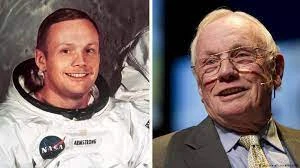

Neil Armstrong in two phases of his life.
Neil Armstrong passed away on August 25, 2012, at the age of 82, due to complications resulting from cardiovascular procedures.