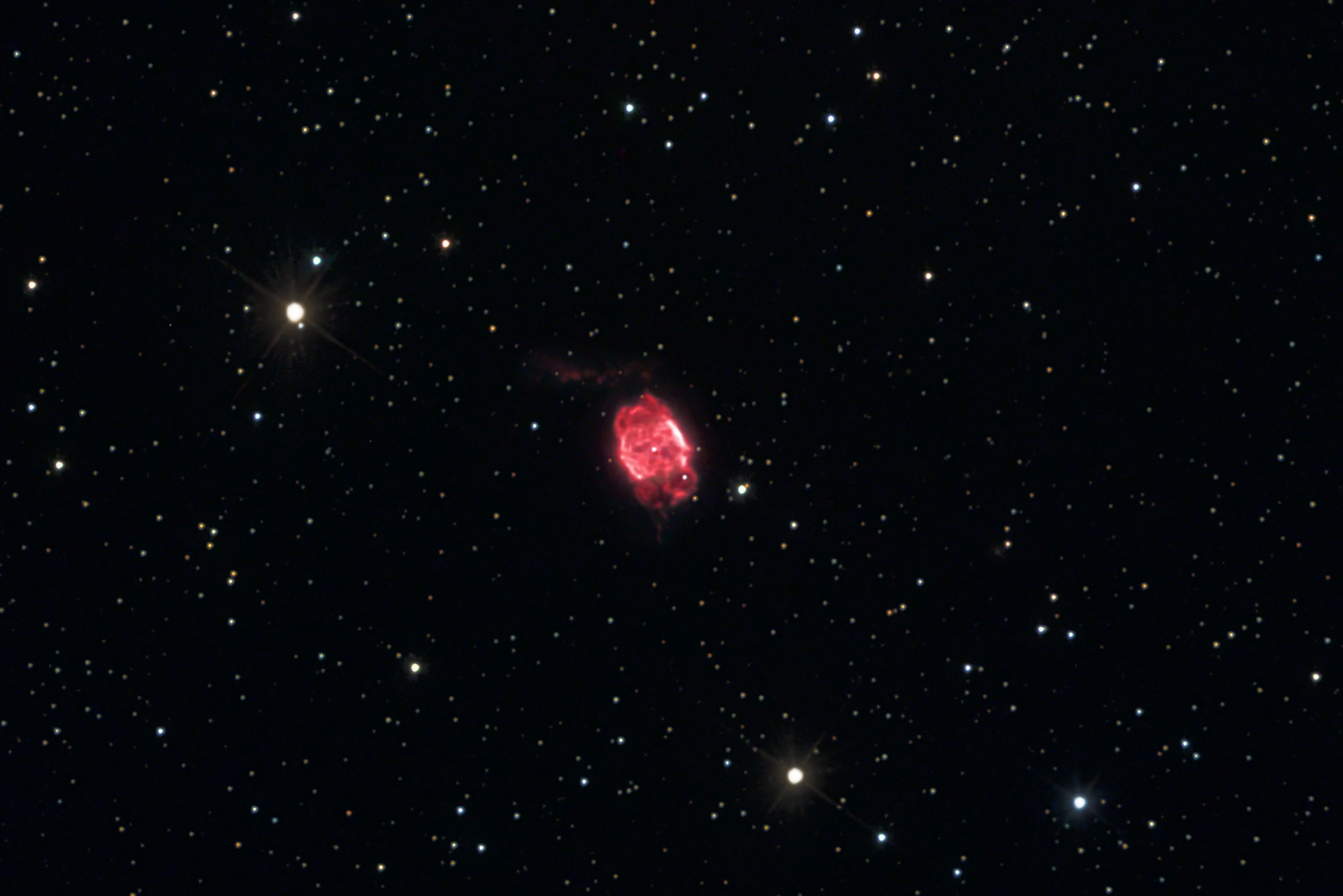
| Bow-Tie Nebula
|
|

As seen from Misti Mountain Observatory.
|
|
|
| Observation Data
|
| Epoch: J2000
|
| Right Ascension: 00h 13m 01.015s[1]
|
| Declination: +72° 31′ 19.085″[1]
|
| Constellation: Cepheus
|
| Apparent Dimensions (V): 38 x 35 arcseconds[2]
|
| Apparent Magnitude (V): 10.7,[1] 11.6[2]
|
| Absolute Magnitude (V):
|
| Characteristics
|
| Type: 3b+b
|
| Radius:
|
| Astrometry
|
| Helio Radial Velocity: -20.50
|
| Redshift: -0.000068
|
| Distance: ~3,500 ly (~1.0 kpc)[2]
|
| Other Designations
|
| Bow-Tie Nebula, Caldwell 2
|
|
NGC 40 (also known as the Bow-Tie Nebula and Caldwell 2) is a planetary nebula discovered by William Herschel on November 25, 1788, and is composed of hot gas around a dying star. The star has ejected its outer layer which has left behind a smaller, hot star with a temperature on the surface of about 50,000 degrees Celsius.[3] Radiation from the star causes the shed outer layer to heat to about 10,000 degrees Celsius,[3] and is about one light-year across.[3] About 30,000 years from now, scientists theorize that NGC 40 will fade away, leaving only a white dwarf star approximately the size of Earth.[3]
References