Minor planets, or planetoids are minor bodies of the Solar system orbiting the Sun (or of other planetary systems orbiting other stars) that are larger than meteoroids (the largest of which might be taken to be around 10 meters or so across) but smaller than major planets (Pluto having a diameter of about 2306 km). The term minor planet is sometimes used as a synonym for asteroid though this is technically incorrect; asteroids are one group of minor planets, a category which also includes Trans-Neptunian objects and other small bodies in our solar system and elsewhere.
The first named minor planet was Ceres, discovered in 1801 by Giuseppe Piazzi. Sir William Herschel (discoverer of Uranus), coined the term asteroid for the first objects discovered in the 19th century, all of which orbit the sun between Mars and Jupiter, and generally in relatively low-eccentricity (i.e., not very elongated) orbits. But since then, minor planets have been found to cross the orbits of planets, from Mercury to Neptune -- with hundreds of transneptunian objects (TNOs) now known to exist well past Neptune's orbit. Though the main distinction between a minor planet and a comet lies in the fact that comets show a coma (or atmosphere) and/or a tail, due primarily to sublimation of ices by solar radiation, one can justifiably consider comets to be a subset of the large group known as minor planets; indeed, some (perhaps all) comets eventually are depleted of their volatile ices and then appear as "stellar" objects, or minor planets.
Minor planets are divided into groups and families based on their orbital characteristics. It is customary to name a group of asteroids after the first member of that group to be discovered (often the largest). While so-called groups are relatively loose dynamical associations, families are much "tighter" and result usually from the catastrophic breakup of a large parent asteroid sometime in the past. Families have only been recognized within the main asteroid belt. They were first recognised by Kiyotsugu Hirayama in 1918 and are often called Hirayama families in his honor.
Groups out to the orbit of Earth
There are relatively few asteroids that orbit close to the Sun. Several of these groups are hypothetical at this point in time, with no members having yet been discovered; as such, the names they have been given are provisional.
- Vulcanoid asteroids are hypothetical asteroids with an aphelion less than 0.4 AU, ie, they orbit entirely within the orbit of Mercury. A few searches for Vulcanoids have been conducted but there have been none discovered so far.
- Apoheles are asteroids whose aphelion is less than 1 AU, meaning they orbit entirely within Earth's orbit. "Apohele" is Hawaiian for "orbit". Other proposed names for this group are Inner-Earth Objects (IEOs) and Anons (as in "Anonymous"). As of May 2004 there are only two known Apoheles: 2003 CP20 and 2004 JG6.
- Mercury-crosser asteroids having a perihelion smaller than Mercury's 0.3075 AU.
- Venus-crosser asteroids having a perihelion smaller than Venus's 0.7184 AU. This group includes the above Mercury-crossers (if their aphelion is greather than Venus' perihelion. All known Mercury crosers satisfy this condition).
- Earth-crosser asteroids having a perihelion smaller than Earth's 0.9833 AU. This group includes the above Mercury- and Venus-crossers, apart from the Apoheles. They are also divided into the
- Aten asteroids having a semi-major axis less than 1 AU, named after 2062 Aten.
- Apollo asteroids having a semi-major axis greater than 1 AU, named after 1862 Apollo.
- Arjuna asteroids are somewhat vaguely defined as having orbits similar to Earth's; ie, with an average orbital radius of around 1 AU and with low eccentricity and inclination. Due to the vagueness of this definition some asteroids belonging to the Apohele, Amor, Apollo or Aten groups can also be classified as Arjunas. The term was introduced by Spacewatch and does not refer to an existing asteroid; examples of Arjunas include 1991 VG.
- Earth Trojans are asteroids located in the Earth-Sun Lagrangian points L4 and L5. Their location in the sky as observed from Earth's surface would be fixed at about 60 degrees east and west of the Sun, and as people tend to search for asteroids at much greater elongations few searches have been done in these locations. No Earth trojans are currently known.
- Near-Earth asteroids is a catch-all group for asteroids whose orbit closely approaches that of Earth. It includes almost all of the above groups, as well as the Amor asteroids.
Groups out to the orbit of Mars
- The Amor asteroids, named after 1221 Amor are Near-Earth asteroids that are not Earth-crossers, having a perihelion just outside the Earth's orbit.
- Mars-crosser asteroids have orbits that cross that of Mars, but do not necessarily closely approach the Earth's.
- Mars Trojans follow or lead Mars on its orbit, at either of the two Lagrangian points 60° ahead (L4) or behind (L5). The only one known is 5261 Eureka. The Minor Planet Center has not listed any Mars trojans with confirmed orbits [1], for controversial reasons.
- Many of the Earth- Venus- and Mercury-crosser asteroids have aphelia greater than 1AU.
The main asteroid belt
The overwhelming majority of known asteroids have orbits lying between the orbits of Mars and Jupiter, roughly between 2 to 4 AU. These couldn't form a planet due to the gravitational influence of Jupiter. Jupiter's gravitational influence, through orbital resonance, clears Kirkwood gaps in the asteroid belt, first recognised by Daniel Kirkwood in 1874.
The region with the densest concentration (lying between the Kirkwood gaps at 2.06 and 3.27 AU, with eccentricities below about 0.3, and inclinations smaller than 30°) is often called the Main belt. It can be further subdivided by the Kirkwood Gaps into the:
- Inner Main Belt, inside of the strong Kirkwood gap at 2.50 AU due to the 3:1 Jupiter orbital resonance. The largest member is 4 Vesta.
- It apparently also includes a group called the Main Belt I asteroids which have a mean orbital radius between 2.3 AU and 2.5 AU and an inclination of less than 18°.
- Middle (or intermediate) Main Belt, between the 3:1 and 5:2 Jupiter orbital resonances, the latter at 2.82 AU. The largest member is 1 Ceres. This group is apparently split into the:
- Main Belt IIa asteroids which have a mean orbital radius between 2.5 AU and 2.706 AU and an inclination less than 33°.
- Main Belt IIb asteroids which have a mean orbital radius between 2.706 AU and 2.82 AU and an inclination less than 33°.
- Outer Main Belt between the 5:2 and 2:1 Jupiter orbital resonances. The largest member is 10 Hygiea. This group is apparently split into the:
- Main Belt IIIa asteroids which have a mean orbital radius between 2.82 AU and 3.03 AU, an eccentricity less than .35, and an inclination less than 30°.
- Main Belt IIIb asteroids which have a mean orbital radius between 3.03 AU and 3.27 AU, an eccentricity less than .35, and an inclination less than 30°.
Families within the main asteroid belt
- Main article: Asteroid family
About 30% to 35% of the bodies in the main belt belong to dynamical families each thought to have a common origin in a past collision between asteroids. A list can be found here.
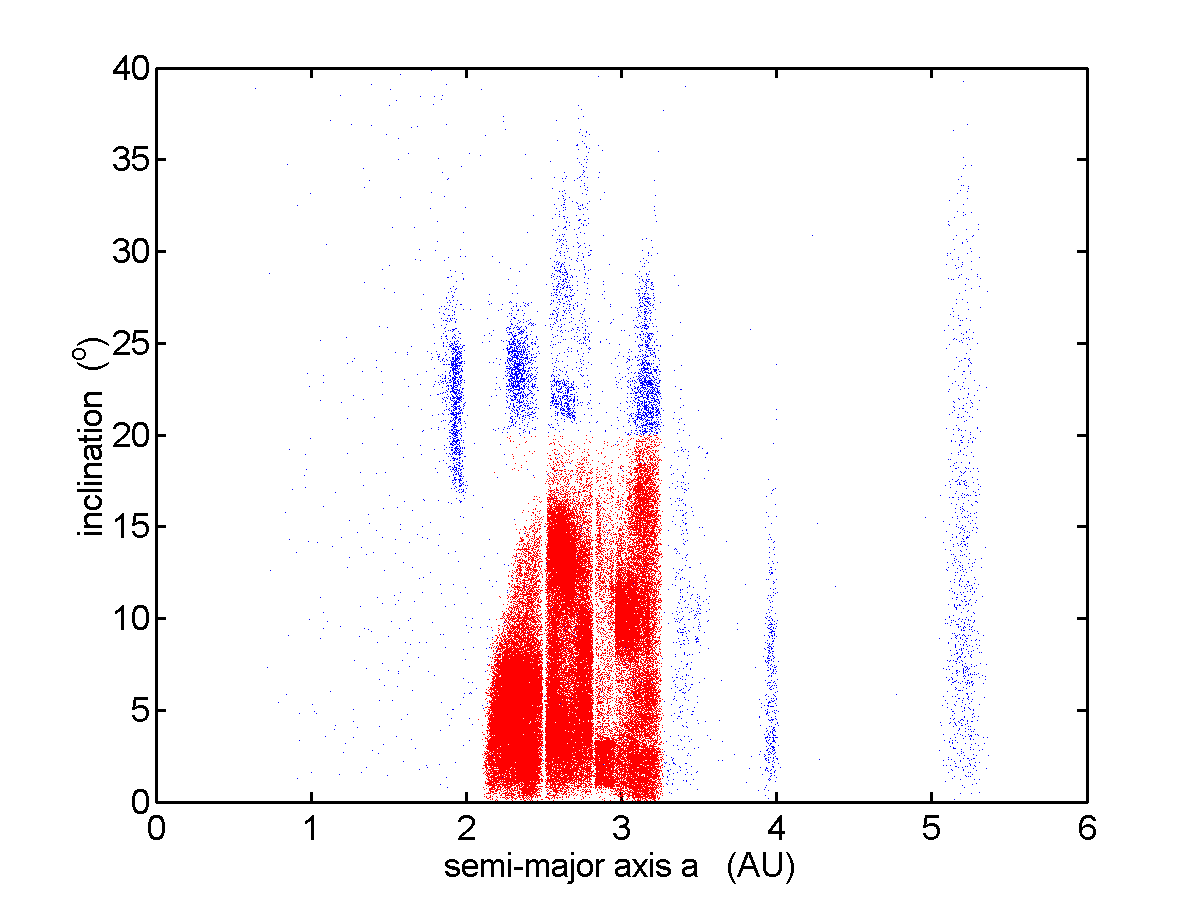

Asteroid groups out to the orbit of Jupiter. The main belt is shown in red
Other groups out to the orbit of Jupiter
There are a number of more or less distinct asteroid groups outside of the Main Belt, distinguished either by mean distance from the Sun, or particular combinations of several orbital elements:
- Hungaria asteroids, with a mean orbital radius between 1.78 AU and 2 AU, an eccentricity less than 0.18, and inclination between 16° and 34°. Named after 434 Hungaria, these are just outside Mars orbit, and are possibly attracted by the 9:2 resonance.
- Phocaea asteroids, with a mean orbital radius between 2.25 AU and 2.5 AU, an eccentricity greater than 0.1, and inclination between 18° and 32°. Some sources group the Phocaeas asteroids with the Hungarias, but the division between the two groups is real and caused by the 4:1 resonance with Jupiter. Named after 25 Phocaea.
- Alinda asteroids have a mean orbital radius of 2.5 AU and an eccentricity between 0.4 and 0.65 (approximately). These objects are held by the 3:1 resonance with Jupiter. Named after 887 Alinda.
- Pallas family asteroids have a mean orbital radius between 2.7 and 2.8 AU and an inclination between 30° and 38°. Named after 2 Pallas.
- Griqua asteroids have an orbital radius between 3.1 AU and 3.27 AU and an eccentricity greater than 0.35. These asteroids are in stable 2:1 libration with Jupiter, in high-inclination orbits. There are about 5 to 10 of these known so far, with 1362 Griqua and 8373 Stephengould the most prominent.
- Cybele asteroids have a mean orbital radius between 3.27 AU and 3.7 AU, an eccentricity less than 0.3, and an inclination less than 25°. This group appears to cluster around the 7:4 resonance with Jupiter. Named after 65 Cybele.
- Hilda asteroids have a mean orbital radius between 3.7 AU and 4.2 AU, an eccentricity greater than 0.07, and an inclination less than 20°. These asteroids are in a 3:2 resonance with Jupiter. Named after 153 Hilda.
- Thule asteroids appear to consist of only one known object, 279 Thule, in a 4:3 resonance with Jupiter.
- Trojan asteroids have a mean orbital radius between 5.05 AU and 5.4 AU, and lie in elongated, curved regions around the two Lagrangian points 60° ahead and behind of Jupiter. The leading point, L4, is called the 'Greek' node and the trailing L5 point is called the 'Trojan' node, after the two opposing camps of the legendary Trojan War; with one exception apiece, objects in each node are named for members of that side of the conflict. 617 Patroclus in the Trojan node and 624 Hektor in the Greek node are "misplaced" in the enemy camps.
There is a forbidden zone between the Hildas and the Trojans (roughly 4.05 AU to 5.0 AU). Aside from 279 Thule and five objects in unstable-looking orbits, Jupiter's gravity has swept everything out of this region.
Groups beyond the orbit of Jupiter
Most of the minor planets beyond the orbit Jupiter are believed to be composed of ices and other volatiles. Many are similar to comets, differing only in that the perihelia of their orbits are too distant from the Sun to produce a significant tail.
- Damocloid asteroids, also known as the "Oort cloud group," are named after 5335 Damocles. They are defined to be objects that have "fallen in" from the Oort cloud, so their aphelia are generally still out past Uranus, but their perihelia are in the inner solar system. They have high eccentricities and sometimes high inclinations, including retrograde orbits. The definition of this group is somewhat fuzzy, and may overlap significantly with comets.
- Centaurs have a mean orbital radius roughly between 5.4 AU and 30 AU. They are currently believed to be Trans-Neptunian Objects that "fell in" after encounters with gas giants. The first of these to be discovered was 2060 Chiron.
- The Neptune Trojans currently consist of four objects: 2001 QR322, 2004 UP10, 2005 TN53, and 2005 TO74.
- Trans-Neptunian Objects (TNOs) are anything with a mean orbital radius greater than 30 AU. This classification includes the Kuiper Belt Objects (KBOs) and the Oort cloud.
- Kuiper Belt Objects extend from roughly 30 AU to 50 AU and are broken into the following subcategories:
- Plutinos are KBOs in a 2:3 resonance with Neptune, just like Pluto. The perihelion of such an object tends to be close to Neptune's orbit (much as happens with Pluto), but when the object comes to perihelion, Neptune alternates between being 90 degrees ahead of and 90 degrees behind of the object, so there's no chance of a collision. The MPC defines any object with a mean orbital radius between 39 AU and 40.5 AU to be a Plutino. 90482 Orcus and 28978 Ixion are among the brightest known.
- Cubewanos, also known as "classical KBOs". They are named after (15760) 1992 QB1 and have a mean orbital radius between approximately 40.5 AU and 47 AU. Cubewanos are objects in the Kuiper belt that didn't get scattered and didn't get locked into a resonance with Neptune.2003 EL61 (with two satellites!) and 2005 FY9 are among the brightest.
- Additional groups exist for other orbital resonances with Neptune than the 2:3 resonance of the Plutinos and the 1:1 resonance of the Neptune Trojans (such as 2001 QR322), but they have not yet been officially named. There are several known objects in the 1:2 resonance, unofficially dubbed "twotinos," with a mean orbital radius of 47.7 AU and an eccentricity of 0.37. There are several objects in the 2:5 resonance (mean orbital radius of 55 AU), and objects in the 4:5, 4:7, 3:5, and 3:4 resonances.
- Scattered Disk Objects (SDOs) unlike cubewanos and resonant objects, they have typically highly inclined, high-eccentricity orbits with perihelia that are still not too far from Neptune's orbit.. They are assumed to be objects that encountered Neptune and were "scattered" out of their initial more circular, close to the ecliptic orbits. The recently famous, Pluto-size 2003 UB313 belongs to this category.
- Extended Scattered Disk (detached) objects with generally highly elliptical, very large orbits of up to a few hundred AU. Their perihelion is too far away from Neptune for any significant interaction to occur. The recently discovered 2000 CR105 is a typical member of the extended disk, while some researchers [2] include Sedna in this class.
- The Oort cloud is a hypothetical cloud of comets with a mean orbital radius between approximately 50,000 AU and 100,000 AU. No Oort cloud objects have been detected, the existence of this classification is only inferred from indirect evidence. Some astronomers have tentatively associated 90377 Sedna with the Oort cloud.
- Kuiper Belt Objects extend from roughly 30 AU to 50 AU and are broken into the following subcategories:
Quasi-satellites and "horseshoe objects"
Some asteroids have unusual horseshoe orbits that are co-orbital with the Earth or some other planet. Examples are 3753 Cruithne and 2002 AA29. The first instance of this type of orbital arrangement was discovered between Saturn's moons Epimetheus and Janus.
Sometimes these "horseshoe objects" temporarily become quasi-satellites for a few decades or a few hundred years, before returning to their prior status. Both Earth and Venus are known to have quasi-satellites.
Such objects, if associated with Earth or Venus or even hypothetically Mercury are a special class of Aten asteroids. However, such objects could be associated with outer planets as well.
See also
- Minor Planet Center
- List of minor planets
- Mesoplanet
References and external links
- Committee on Small Body Nomenclature
- List of minor planet orbital groupings and families from ProjectPluto
- Cunningham, Clifford, "Introduction to Asteroids: The Next Frontier", ISBN 0943396166
- James L. Hilton: When Did the Asteroids Become Minor Planets?
- Kirkwood, Daniel; Relations between the Motions of some of the Minor Planets (1874).
- Schmadel, L.D. (2003). Dictionary of Minor Planet Names. 5th ed. IAU/Springer-Verlag: Heidelberg.
- Large amount of information on asteroid groups collected by Gérard Faure, translation Richard Miles.
| The minor planets |
|---|
| Vulcanoids | Near-Earth asteroids | Main belt | Jupiter Trojans | Centaurs | Damocloids | Comets | Trans-Neptunians (Kuiper belt · Scattered disc · Oort cloud) |
| For other objects and regions, see: asteroid groups and families, binary asteroids, asteroid moons and the Solar system For a complete listing, see: List of asteroids. See also Pronunciation of asteroid names and Meanings of asteroid names. |