Charon (greek Χάρων) also 134340 Pluto I is a natural satellite of Pluto discovered in 1978. Its the largest satellite of Pluto with a diameter of 1212 km, this also makes it the sixth largest trans-neptunian object overall (behind Pluto, Eris, Haumea, Makemake and Gonggong).
Charon is half Pluto's size and one eigth of its mass, so its gravitational influence is so strong that instead of orbiting Pluto the system orbits a point between Pluto and Charon. Pluto and Charon are also tidally locked to each other, together with Eris-Dysnomia the only two exampls of confirmed mutual tidal lock in the system (Orcus-Vanth might be a third one).
The reddish-brown cap on Charon's northern pole is made of tholins - organic macromolecules which might be essential components of life. The ones on Charon specifically are made of nitrogen, methane and related gases which could be formed by the moon's cryovolcanoes or even gifted by Pluto from its atmosphere 19 000 km away.
New Horizons was 27 000 km away from Charon at closest point in 2015.
Historically Charon was considered Pluto's satellite, but later an opinion spread that Pluto and Charon are a double planet because they spin around each other instead of one around the other. IAU promised 20 years ago they wlll make a definition for double planets, but for now Charon is a satellite of Pluto. They never did it btw.
Charon is significantly darker than Pluto, which likely means Pluto and Charon's composition is different.
Discovery
Charon was discovered by an american astrophysicist James Christy on 22 June 1978, however it was predicted by soviet astrophysicist Rolan Kiladze a year earlier.
James Christy was examining zoomed in images of Pluto taken 2 months earlier, and on some the planet had a stretched form, while the stars around it seemed normal. This could mean the telescope is not strong enough to capture both Pluto and its hypothetical satellite, showing them together. This was confirmed on plates dating as far back as 1965.
IAU published the discovery on 7 July 1978. This also led to significant changes in Pluto's characteristics, because the combined characteristics of Pluto and Charon used to be attributed to Pluto alone.
All doubts about Charon vanished when it entered a five year period of mutual transits and eclipses with Pluto in 1985-1990. These periods occur when Pluto-Charon orbital plane is edge-on as seen from Earth, and they happen twice every Pluto's 248-year long orbital period. It was very lucky one happened soon after Charon's discovery.
Name
Charon was given the temporary designation S/1978 P 1, following then recently set standard. Christy first suggested the name Oz (fantasy world from a children's novel) on June 24, then the name Charon as a scientific-sounding version of his wife Charlene's nickname "Char".
Although his colleagues at the observatory proposed the name Persephone, Christy stuck with the name Charon because he found out theres a mythological figure wearing the same name - a ferryman of the dead closely associated with the god Pluto itself. The name Charon was made official on 3 January 1986.
Interestingly, almost 40 years before Charon's discovery science fiction writer Edmond Hamilton invented three moons of Pluto for his novel Calling Captain Future in 1940, naming them... Charon, Styx and Cerberus. All 3 names are used for actual Pluto satellites now.
There is a slight debate about the correct pronunciation of Charon. The mythological figure is pronounced like "Karon", but Christy himself pronunced it as "Sharon". Most english speaking astronomers follow the name "Karon", but others follow Christy's, and also Sharon is the prescribed pronuncination of NASA and New Horizons team.
Orbit
Charon and Pluto orbit each other with a period of ~6.4 days. The two are mutually tidally locked, so Pluto shows only one side of itself to Charon, and Charon to Pluto. Moon is also tidally locked to Earth, showing only one part of itself to it, but Earth is not tidally locked to Moon.
The avearage distance between Pluto and Charon is 19 596 kilometers. The avearage distance from Charon to centre of the Pluto-Charon system is 17 181 kilometers.
Formation
Pluto and Charon are thought to have been two bodies that collided before going into orbit around each other. The collision was violent enough to boil off volatile ices like methane but not violent enough for either to be destroyed. Pluto and Charon were stuck for a while until separating again, staying gravitationally bound.
Physical characteristics
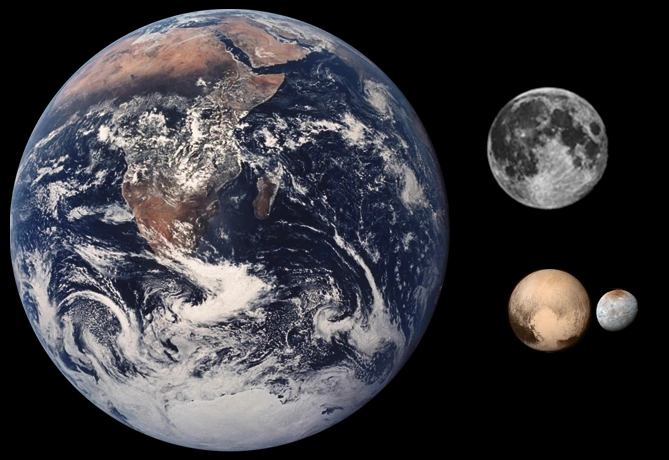

Charon is 1212 kilometers in diameter, just slightly more than half of Pluto's diameter and larger than the dwarf planet Ceres. Charon is the 12th largest moon in the Solar System. Its simillar in size to satellites of Uranus Ariel and Umbriel.
Charon's slow rotation suggests there should be a little flatenning or tidal distortion if Charon is in hydrostatic equilibrium, but any deviations from a perfect sphere are too tiny to be noticed by New Horizons. This is in contrast to Saturn's Iapetus, which is simmilar in size to Charon but has a noticeable oblateness. Charon not having it either means its in hydrostatic equillibrium right now or that it got its orbit early in its history, when it was still warm.
Charon is only 8x less massive than Pluto is, compared to Moon 81x less massive than Earth. Because of that the barycentre of the system is outside of Pluto, which means instead of Charon orbiting Pluto they orbit each other. Because of this Pluto-Charon was refered to as a double planet. In addition, four smaller satellites orbit the Pluto-Charon barycentre, which might be a small model of circumbinary planets - planets orbiting the barycentre of a binary star.
Internal structure
unfinished
Charon's volume and mass allow us to calculate its density - 1.7 g/cm3, which is slightly less dense than Pluto. The composition is around 55% rock / 45% ice compared to Pluto being 70% rock.
Pluto * Charon * Nix * Hydra * Kerberos * Styx